


You might assume that choosing between the two most popular paint markers is just a matter of "big" versus "small," but picking the wrong tip can quickly turn a relaxing afternoon of drawing into a frustrating battle with blotchy lines or tedious filling. It is a common dilemma for creators across Australia, whether you are customising a pair of sneakers or detailing a fresh canvas. Most of us have felt that sting of regret after buying a marker that is too chunky for fine details or one that takes far too long to colour in a simple background.
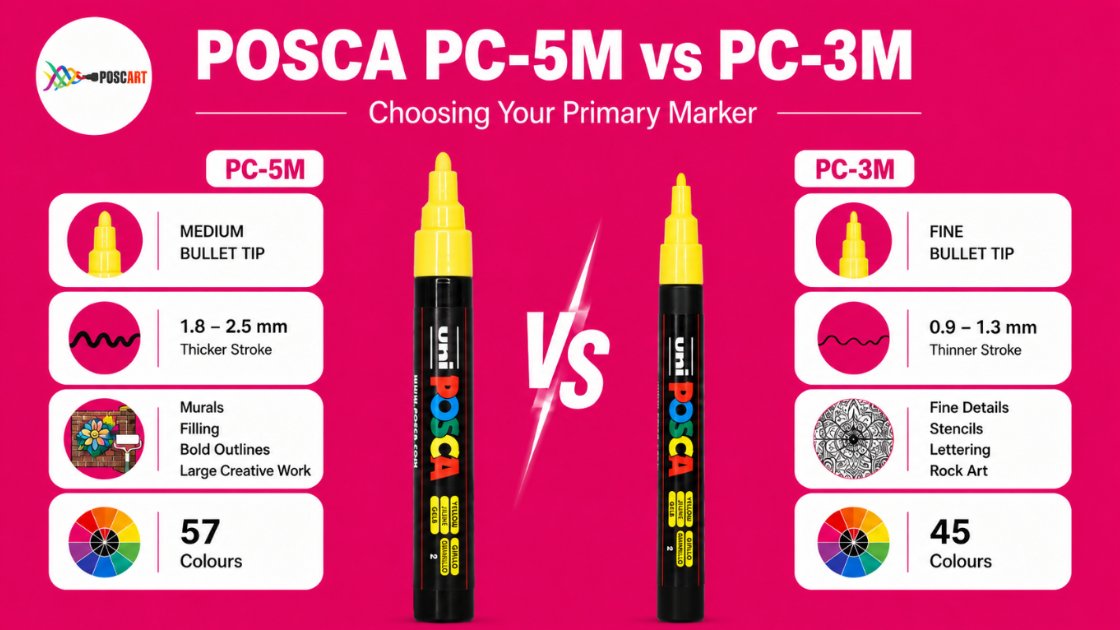
In this guide, we dive deep into the posca pc-5m vs pc-3m comparison to help you discover the technical differences and practical uses of these creative essentials. You'll gain a clear understanding of the 0.9–1.3mm fine tip versus the 1.8–2.5mm medium bullet tip, giving you the confidence to choose the right marker for any surface. We'll also share our specialist tips on maintaining your markers and how to organise your collection so they stay in peak condition for every future project.
Key Takeaways
- Identify the exact line widths of each model, from the 0.9–1.3mm fine tip to the 1.8–2.5mm medium bullet, to ensure your marker matches the scale of your project.
- Resolve the naming confusion of the posca pc-5m vs pc-3m by learning which marker is the industry standard for coverage and which excels at intricate line work.
- Master the "Layering Rule" to achieve professional depth by using the PC-5M for bold base colours and the PC-3M for sharp, final details.
- Discover the essential steps for activating and priming your markers correctly to avoid nib flooding and keep your paint pens flowing smoothly.
- Evaluate whether a high-value bundle or a personalised selection of individual colours is the best way to build your professional art kit.
Understanding the POSCA PC-5M and PC-3M Difference
POSCA has become a staple in Australian art studios and classrooms. While the range includes everything from ultra-fine pins to massive mop-style markers, the bullet tip family remains the most sought-after choice. For most creators, the real debate centres on the posca pc-5m vs pc-3m. These two sizes represent the perfect balance between coverage and control. They are frequently the first markers a beginner will pick up because they handle nearly any creative task with ease.
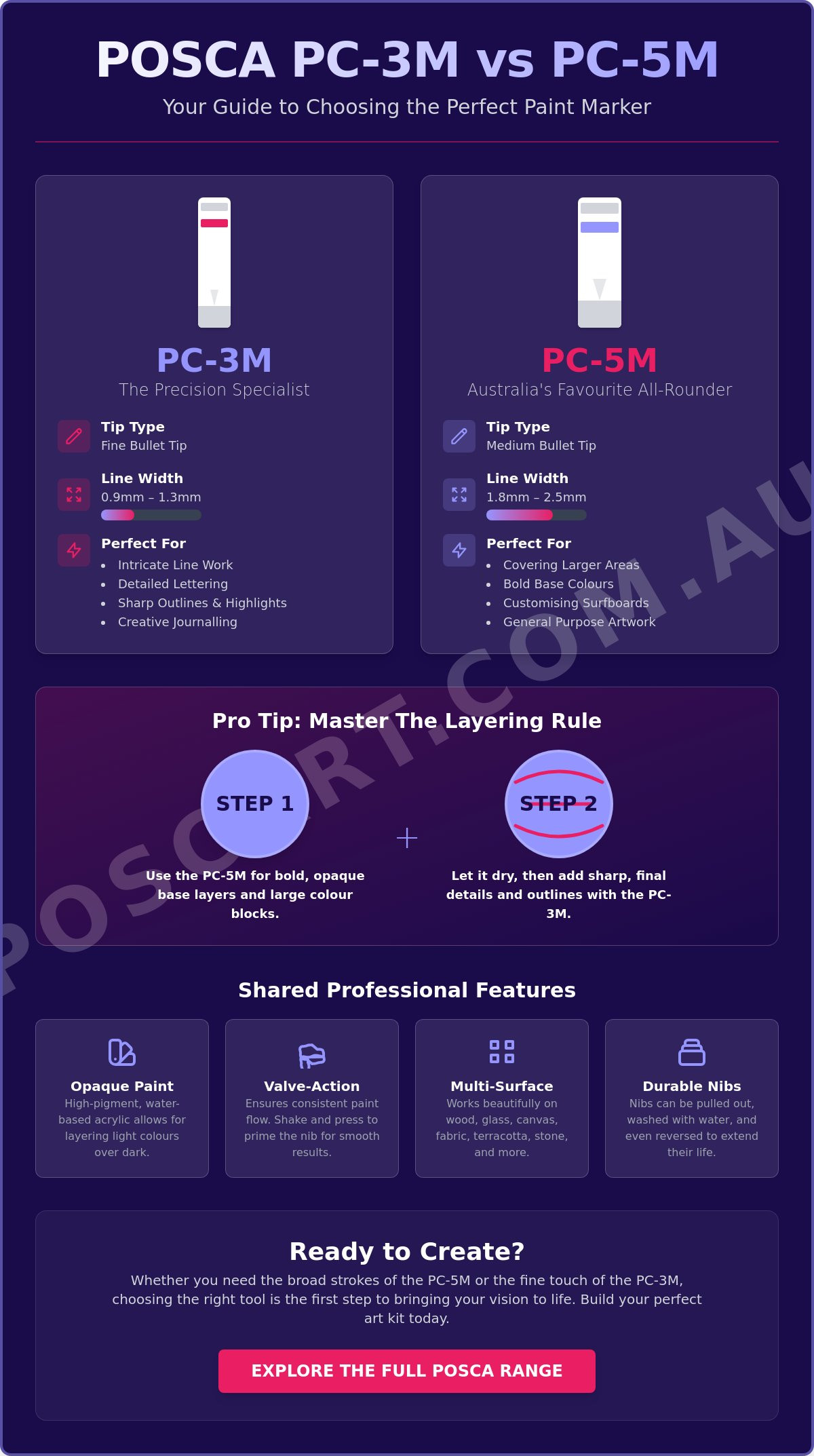
At its core, a paint marker like a POSCA uses high-quality water-based acrylic paint that is both opaque and lightfast. This means you can layer light colours over dark ones, a feature that makes the PC-5M and PC-3M duo so powerful. Whether you are working on wood, glass, or fabric, understanding the specific strengths of each tip will help you avoid common mistakes like choosing a nib that is too wide for small details or too small for large fill areas.
The PC-5M: Australia’s Favourite All-Rounder
The PC-5M is widely considered the industry standard for medium bullet tips. It produces a line width between 1.8mm and 2.5mm, depending on the pressure you apply and the angle of the pen. This versatility makes it the go-to choice for larger projects. You'll often see Australian artists using it for customising surfboards and skateboards because it covers surface area quickly without losing the ability to define shapes. If you are looking to expand your kit, the POSCA PC-5M colour range offers dozens of shades, allowing for seamless blending and bold blocks of colour.
The PC-3M: The Precision Fine Bullet
When your work requires a tighter touch, the PC-3M steps in as the precision specialist. With a line width ranging from 0.9mm to 1.3mm, this fine bullet tip is designed for illustration, detailed lettering, and creative journalling. It offers a level of control that the larger 5M simply cannot match. Creators use the 3M to add intricate patterns, sharp outlines, or delicate highlights that make a piece pop. It's the essential companion for any artist who needs to work within confined spaces or on smaller canvases without the paint flooding their delicate line work. Deciding between the posca pc-5m vs pc-3m often comes down to the scale of your canvas and the level of detail your style demands.
Technical Comparison: Line Width and Ink Flow
Understanding the physical mechanics of your tools is the first step toward better art. When looking at the posca pc-5m vs pc-3m, the differences start with the nib material itself. Both models utilise high-density polyester fibres, but the structure of the 5M is noticeably more robust. This medium bullet tip is designed to withstand higher pressure, making it ideal for the "pump" action required to keep ink flowing during large-scale work. Inside every pen, a small metal ball-bearing rattles to ensure pigments are perfectly suspended. Without this distribution, the paint could become watery or unevenly coloured.
The ink delivery system relies on a valve-action mechanism. A chemical analysis of POSCA marker ink reveals a high pigment load that provides the signature opacity artists love. In the PC-5M, the wider valve allows for a more generous flow, which is necessary to saturate the larger nib. The PC-3M, conversely, uses a more restricted flow to maintain the precision of its 0.9–1.3mm line. This prevents the "puddling" that can occur when a fine tip is overloaded with paint. Unlike chisel or brush tips, these bullet shapes provide a consistent, predictable line regardless of the direction you move the pen.
Stroke Width and Coverage Speed
Speed is a major factor when choosing your marker. If you were to fill a 10cm x 10cm square, the PC-5M would complete the task in roughly half the time of a PC-3M. The 1.8–2.5mm stroke width of the 5M provides a thick, juicy layer of paint that is perfect for base coats on porous surfaces like canvas or terracotta. While you can certainly use a PC-3M for filling, it's better reserved for tighter areas where a larger tip would bleed over your outlines. Pressure also plays a role; a light touch with the 5M can mimic a heavy stroke from the 3M, but the 3M remains the king of consistent thin lines.
Nib Durability and Reversibility
One of the most practical features of these markers is their longevity. Both the 3M and 5M nibs can be pulled out, washed, or even reversed if one end becomes frayed. The PC-5M nib is particularly resilient when used on rougher textures like raw timber or stone. If your tip does eventually wear out from heavy use on abrasive surfaces, you can easily find replacement nibs to extend the life of your pen. For a detailed walkthrough on this process, check our POSCA pen tips replacement guide. If you're still unsure which technical spec fits your current project, feel free to ask our creative support team for a recommendation.
Choosing the Right Tip for Your Creative Project
Deciding on the posca pc-5m vs pc-3m often comes down to the scale of your vision. While technical specs tell part of the story, the way these markers interact with your specific canvas is what matters most in the studio. A common strategy among professional illustrators is the "Layering Rule." This involves using the broader PC-5M to lay down solid base colours and larger shapes, then switching to the PC-3M once the paint is touch-dry to add sharp outlines and intricate highlights. This approach ensures your work has depth without the risk of the finer nib getting clogged by wet paint from the broader marker.
Surface texture is another critical factor that dictates which pen you should grab first. In Australia, many hobbyists enjoy painting on natural materials like local sandstone or rough terracotta. These porous surfaces absorb paint quickly; the generous flow of the PC-5M is much more effective here for initial coverage. Conversely, if you are working on non-porous surfaces like smooth glass or polished metal, the PC-3M provides the necessary friction and control to prevent the paint from slipping or pooling. It is always a good idea to practise techniques on a scrap piece of the same material before committing to your final piece.
Best Uses for the PC-5M Medium Bullet
The PC-5M is the workhorse of the POSCA family. It is the ideal choice for large-scale mural work or when you need to fill bold character designs on a canvas. Because it covers more ground with fewer strokes, it is also the most practical option for school workshops and classroom settings. Teachers often prefer the 5M because students can see immediate results on various surfaces, from cardboard to plastic, without the frustration of a nib that feels too small for the task.
Best Uses for the PC-3M Fine Bullet
When the heavy lifting is done, the PC-3M steps in to provide the finishing touches. This fine bullet tip is the specialist for adding organic textures like hair, fur, or complex stippling. If you are creating personalised greeting cards or working in a tightly packed sketchbook, the 3M offers the precision needed for legible lettering and delicate patterns. It is the essential tool for outlining designs previously blocked in with larger markers; this ensures your edges stay crisp and professional. Many Australian designers keep a handful of 3M markers in their kit specifically for these high-detail moments.
Activation and Maintenance for Professional Results
Getting the most out of your paint markers begins before the first stroke hits the paper. Proper activation ensures the pigment is perfectly mixed and ready to flow. Whether you are using the posca pc-5m vs pc-3m, the initial process is identical: shake the marker vigorously with the cap on to engage the internal ball-bearing. This mixes the water-based acrylic paint to a consistent opacity. For a detailed walkthrough on this first step, follow our guide to activating your POSCA pens correctly to ensure they last as long as possible.
Once activated, storage becomes the next priority for longevity. Many hobbyists instinctively store pens upright in a jar, but horizontal storage is the professional choice. Keeping your markers flat prevents pigment from settling at the very bottom of the barrel and keeps the internal valve from becoming clogged. It also ensures the ball-bearing remains free to move the next time you pick up your pen to create.
Priming the PC-3M vs the PC-5M
The physical size of the nib dictates how you should prime your marker. The PC-3M features a smaller, more delicate valve system that requires a lighter touch. If you pump the 3M tip too aggressively on a hard surface, you risk flooding the nib and creating "blobs." This is particularly common when working on non-porous surfaces like plastic or glass where the paint has nowhere to soak in. The PC-5M is slightly more forgiving due to its larger reservoir, but you should still stop pumping the moment you see the first hint of colour saturating the polyester fibres. A fully primed nib should look damp with pigment but not dripping.
Replacing and Cleaning Nibs
Nibs can occasionally become scratchy if they pick up dust or dried paint from previous layers. Because POSCA markers use water-based paint, you can often restore a clogged tip by removing it and soaking it in a small bowl of warm water overnight. Let the nib dry completely before reinserting it into the marker barrel. If a nib is frayed beyond repair after heavy use on rough timber or stone, it is more efficient to simply buy replacement nibs rather than struggling with a damaged tip.
Australian artists should be especially mindful of our local climate. Storing your collection in a hot studio or near a sunny windowsill will cause the paint to thicken and the nibs to dry out prematurely. Always keep your markers in a cool, shaded spot to maintain that signature smooth flow. If you have any specific questions about reviving an old set, don't hesitate to contact our creative mentors for personalised advice.
The Verdict: Should You Buy a Set or Individual Pens?
Choosing between the posca pc-5m vs pc-3m doesn't have to be a restrictive "either/or" decision. For the majority of Australian artists, the most effective toolkit includes a strategic combination of both sizes. If you're building your first kit, we recommend securing at least a black and a white marker in both the 3M and 5M tips. These are the essential "must-haves" for any project. The 5M white is perfect for laying down broad highlights on a surfboard or canvas, while the 3M white allows you to add tiny glints of light or fine corrections. Having both sizes in black ensures you can outline large shapes and add intricate linework with equal ease.
Your final choice should reflect the scale of your style. If your work features bold characters and large blocks of colour, the PC-5M is your primary tool. If you lean toward technical illustration or detailed patterns, the PC-3M will be your best friend. Most creators find that starting with the larger tip for base layers and finishing with the finer tip for detail creates the most professional results. This dual-size approach prevents your fine nibs from wearing out prematurely on broad fill areas while keeping your details sharp and legible.
The Value of POSCA Bundles
Investing in a set is almost always more cost-effective than buying eight or ten markers separately. For those who want the full spectrum of creative possibilities, a PC-5M bundle provides an incredible range of 57 colours. This ensures you always have the right shade for large-scale coverage without having to pause your project to order more. Detailed illustrators might prefer to start with PC-3M sets, which offer 45 shades tailored for intricate work. Our personalised bundles are designed to help Australian artists at every level get the right tools without the guesswork, providing a balanced palette from the moment you open the box.
Building Your Custom Toolkit at PoscART
Sometimes a specific project demands a very particular palette rather than a full rainbow. If you're customising a pair of sneakers with coastal tones or a skateboard with neon accents, buying individual pens allows you to build a kit that matches your vision perfectly. You can also round out your setup with essential art accessories like sturdy storage cases to keep your markers organised or protective varnishes to seal your hard work against the elements. By choosing PoscART, you're supporting a local Australian family business dedicated to providing genuine supplies and expert advice to the creative community. Whether you choose the PC-5M for its bold presence or the PC-3M for its sharp precision, you'll have the confidence to tackle any creative challenge that comes your way.
Elevate Your Art with the Perfect POSCA Pair
Mastering your creative tools is the fastest way to see professional results in your work. You now understand that the posca pc-5m vs pc-3m choice isn't about which marker is better, but about which one serves your specific project needs. The PC-5M remains the reliable workhorse for bold coverage and base layers, while the PC-3M provides the essential precision for those intricate final touches. Whether you are customising surfboards in Queensland or sketching in a Melbourne cafe, having both sizes in your kit ensures you are never limited by your tools.
As a specialist Australian family-owned and operated store, PoscART is dedicated to helping you find exactly what you need. We offer an extensive range of individual pens and custom bundles to suit every artistic level, with genuine supplies shipped nationwide. If you need personalised advice on building your ideal collection or help choosing the right colour palette, feel free to reach out to our creative mentors at PoscART. We're here to support your journey and help you create something truly remarkable. Happy drawing!
Frequently Asked Questions
Can I use a PC-5M nib in a PC-3M marker body?
No, you cannot swap nibs between these two models because the barrel diameters and internal valve mechanisms are different sizes. The PC-5M nib is significantly wider to accommodate a larger paint flow, while the PC-3M is designed for a narrower housing. Attempting to force a larger nib into a smaller marker body will likely damage the valve and cause the paint to leak.
Which POSCA size is best for painting on rocks?
The PC-5M is generally the most effective choice for rock painting because its 1.8–2.5mm tip covers porous stone surfaces quickly. It provides a solid base layer without the nib wearing down as fast as a finer point might on rough textures. For the final intricate details or fine outlines on your stone art, you can then switch to a PC-3M once the base is dry.
Are the ink colours identical between the PC-5M and PC-3M ranges?
Yes, the ink formula and pigments are exactly the same across all sizes in the posca pc-5m vs pc-3m comparison. A specific shade like "Sky Blue" will match perfectly regardless of which tip size you choose. This consistency is a major advantage for artists who need to switch between broad coverage and fine detailing on a single piece of work without any visible colour shifts.
How long do POSCA markers take to dry on different surfaces?
Drying times usually range from one to five minutes depending on the absorbency of your material and the local humidity. On porous surfaces like paper or raw timber, the paint often dries in under sixty seconds. For non-porous surfaces like plastic, metal, or glass, it's best to wait at least five minutes to ensure the paint has fully set before you attempt to layer another colour on top.
Can I refill my PC-5M or PC-3M markers when they run out?
No, these markers are designed as single-use tools and do not have a refillable reservoir. The barrel is hermetically sealed during manufacturing to protect the specific consistency of the water-based acrylic paint. While you can replace the nibs if they become worn or clogged, you will need to buy a new marker once the internal paint supply is exhausted.
What is the best way to store my POSCA pens in the Australian climate?
You should store your markers horizontally in a cool, shaded area to prevent the paint from drying out or the pressure from building up. The Australian heat can cause the air inside the barrel to expand, which often leads to leaks when you next remove the cap. Keeping them flat ensures the pigment remains well-distributed and the internal ball-bearing doesn't get stuck in settled paint.
Is the PC-3M fine enough for detailed calligraphy?
The PC-3M is a fantastic tool for faux-calligraphy and bold hand-lettering, though it doesn't have the flexible tip required for traditional copperplate styles. Because it's a fixed bullet tip, you'll need to manually draw your thick downstrokes to create the illusion of calligraphic variation. It's a favourite for sign-writing and bullet journalling where consistent, legible lines are the priority.
Why is my POSCA marker leaking paint from the nib?
Leaking is typically caused by over-priming the nib or storing the marker in a spot that gets too warm. If you pump the tip too many times, the valve can stay open and allow a flood of paint to escape. If this happens, carefully pull out the nib, rinse it under warm water, wipe the housing clean, and store the pen horizontally to let the internal pressure equalise.
General Information
This article is provided as general information only to help customers compare and choose POSCA markers, acrylic markers, art supplies, creative tools and related products. Product details, colours, finishes, surface suitability, availability, pricing and usage results may vary. Always check the individual product page, manufacturer information, age guidance, surface instructions and safety recommendations before purchasing or using a product.