







POSCA Pastel Sets Review: The Ultimate Guide for Australian Artists (2026)
Have you ever reached the final stages of a creative project only to have a stray smudge of pastel dust ruin your crisp lines? It is a common frustration for Australian artists who crave the rich, tactile experience of pastels but hate the messy residue that traditional soft sets leave behind. You might also find yourself confused by the difference between pastel-coloured markers and these actual wax-based sticks. In this posca pastel sets review, we'll dive deep into whether these professional-grade tools are the right fit for your studio.
We agree that a great medium should offer vibrant, smooth colours without the chalky cleanup or the poor blending found in cheaper sets. This guide promises to help you discover if the POSCA Pastel range is the ultimate choice for your next piece by examining its texture and performance. We'll preview how these sticks layer over POSCA paint markers, their results on surfaces like wood and glass, and how they handle blending to create a polished, professional finish. Whether you're a student or a seasoned professional, you'll find the practical advice you need to create with confidence.
Key Takeaways
- Understand the ergonomic design and durable carry case of the KPE-200 range, making these professional-grade tools ideal for both studio work and sketching outdoors.
- Discover how the high-wax, low-residue formula performs in our posca pastel sets review, providing a smudge-free alternative to traditional soft pastels.
- Learn the practical differences between wax pastel sticks and pastel-coloured paint markers to ensure you select the right tool for precision or textured layering.
- Master advanced application methods like Sgraffito and stippling to create unique, professional textures inspired by the Australian landscape.
- Gain confidence in your creative supplies by sourcing genuine Uni-ball products from a specialised Australian retailer to avoid the common issue of counterfeit sets.
Unboxing the POSCA Pastel Experience: More Than Just a Crayon
Unboxing a fresh set of art supplies is always a thrill for any creator. When you first open the POSCA Pastel (KPE-200) range, you'll immediately notice that these aren't your standard childhood crayons. They feel substantial and professional in the hand. The durable plastic carry case is a standout feature for a busy studio, keeping your workspace organised while protecting the sticks from accidental breakage. In this posca pastel sets review, we're looking at how these tools stand up to the demands of modern Australian artists who need reliability and vibrancy in one package.
The ergonomic design of each stick allows for a comfortable grip, which is essential for long drawing sessions or detailed illustration work. Unlike cheaper alternatives, these have a distinct high-wax feel that translates to a smooth, controlled application on the page. You won't find the crumbly, dusty mess often associated with traditional soft pastels. Instead, you get a clean, matte finish that feels contemporary and high-end. The initial colour payoff is impressive, with the pigments appearing rich and saturated from the very first stroke.
What Exactly Are POSCA Pastels?
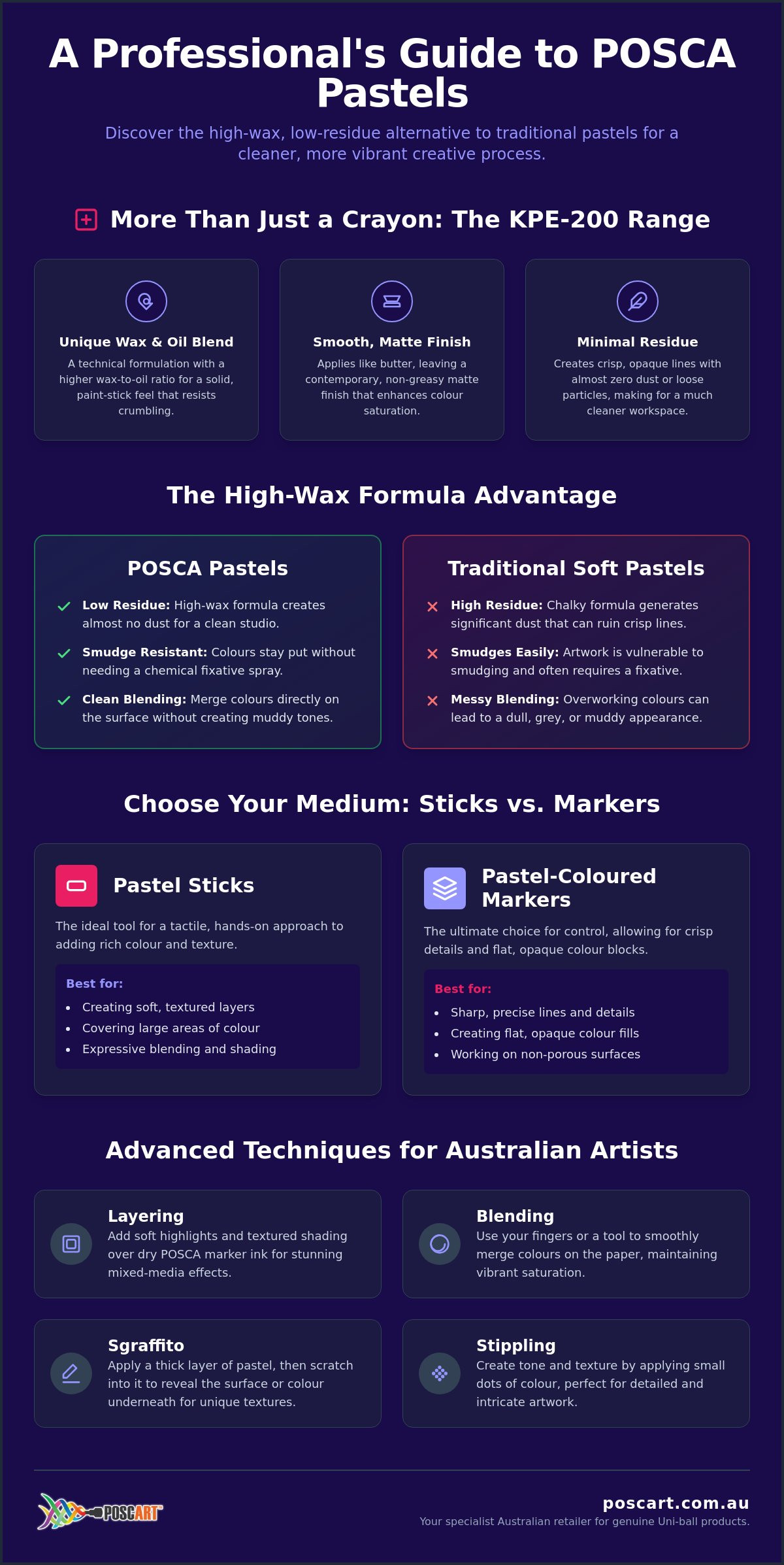
These sticks are a unique technical blend of wax and oil. This specific formulation is what gives them their signature smooth, matte finish that resists smudging better than oil-only alternatives. While the history of pastels is traditionally rooted in dry, chalky pigments, POSCA has re-engineered the medium for the 21st century. They are versatile enough for everyone from professional illustrators to weekend hobbyists. Many Australian artists are now choosing this wax-based media for mixed-media projects because they provide a stable layer that stays exactly where you put it.
The 24-Colour Set Breakdown
The 24-colour palette is impressively balanced for a variety of subjects. You'll find primary bolds that pop off the page alongside soft tints that are perfect for subtle shading, highlights, or skin tones. Having the protective case is a massive benefit for organising your workspace; it ensures every shade has its place and won't get lost in the bottom of a supply bag. The POSCA Pastel is a wax-heavy drawing tool designed for minimal residue. This makes it a clean alternative for classroom environments or shared studio spaces where dust can be a concern. Because PoscART specialises in genuine POSCA Pastel Sets, you can be confident you're getting the authentic KPE-200 experience rather than a low-quality imitation. This set is a versatile addition to any kit, offering a tactile way to add depth and texture to your work.
Performance Analysis: Why the High-Wax Formula Wins
The technical secret behind the success of the KPE-200 range lies in its specific chemical composition. Unlike traditional oil pastels that rely heavily on oils and fats, POSCA has engineered a formula with a higher wax-to-oil ratio. This creates a drawing tool that behaves more like a solid paint stick than a messy crayon. In this posca pastel sets review, the most immediate benefit of this formula is the "Residue Test." When you glide a stick across the page, it leaves behind a crisp, opaque line with almost zero dust or loose particles. This is a significant departure from soft pastels, which often require a fixative to prevent smudging.
Blending these pastels is a surprisingly clean experience. Because the formula isn't overly gummy, you can merge two colours directly on the paper without them turning into a muddy grey. The pigments sit on the surface of the paper tooth, allowing for vibrant mixing that maintains its saturation. Regarding permanence, these pastels are designed to be lightfast. This means your work won't fade quickly when exposed to the harsh Australian sun, making them a reliable choice for professional pieces intended for display or sale.
Smoothness and Application
The application feels buttery and consistent, especially when working on high-quality, heavy-grain paper. You can achieve fine, sharp lines by using the edge of the stick, or cover large areas quickly by using the side. One of the most exciting features for mixed-media artists is how well these sticks layer over dry POSCA marker ink. This allows you to add soft highlights or textured shading on top of the flat, opaque colours of your paint pens. To push your work further, you can experiment with advanced pastel techniques like sgraffito or heavy impasto layering to create physical depth in your illustrations.
The Clean-Up Advantage
The lack of chalky dust makes these pastels a favourite for home studios and classroom environments. You won't find yourself covered in pigment at the end of a session, and your workspace stays remarkably tidy. If a small amount of residue does occur, it's usually in the form of tiny wax "crumbs" that can be easily brushed away without staining the paper. To keep your colours bright, simply wipe the tip of the pastel on a scrap piece of paper between colour changes to remove any picked-up pigment. If you aren't sure which set suits your specific surface, feel free to ask our team for advice on the best combinations for your project.
Choosing Your Medium: Pastel Sticks vs. Pastel Paint Markers
One of the most frequent questions we receive at PoscART involves the difference between the POSCA PC-5M Pastel set and the KPE-200 Pastel sticks. While they share the same famous colour palette, they are entirely different tools. The markers are filled with liquid, water-based acrylic paint, whereas the sticks are solid drawing tools. In this posca pastel sets review, it's vital to understand that your choice depends on whether you value sharp precision or expressive texture. Markers provide flat, opaque coverage that is perfect for graphic design and clean outlines. Sticks, on the other hand, offer a tactile experience that allows for soft shading and painterly strokes that markers simply cannot replicate.
To better understand why these sticks behave the way they do, it's helpful to look at the history and composition of oil pastels; traditional versions use non-drying oils, but POSCA's high-wax formula ensures a much cleaner finish. Many Australian artists find that a hybrid approach works best. You can use POSCA marker sets to block in your primary shapes and structural lines, then layer the pastel sticks over the top to add atmospheric depth and highlights. This combination gives your artwork a professional, multi-dimensional look that stands out on any gallery wall or social media feed.
Precision vs. Expression
The control of a medium bullet tip is unmatched for lettering or intricate patterns. If you're a beginner, you might find the familiar feel of a pen easier to manage. However, the KPE-200 sticks offer a level of gestural freedom that encourages more creative risk-taking. They are ideal for capturing the raw, rugged textures of the Australian outback or sea-foam on a coastal landscape. If you're working on a massive scale, you might reach for a broad tip marker to fill space, but the pastels provide a hand-drawn quality that feels more intimate and artistic.
Surface Compatibility Comparison
Surface choice is the final piece of the puzzle. Paint markers are the kings of non-porous surfaces like glass, metal, and plastic, where they bond quickly and dry to a hard finish. While pastels can be used on these materials for a translucent effect, they truly shine on surfaces with a bit of "tooth," such as heavy paper, canvas, or raw wood. Regardless of which medium you choose, sealing your work is essential to prevent wear and tear. Choosing the right base material ensures your pigments stay vibrant and your hard work remains protected for years to come.
Pro Techniques: Heat, Scratching, and Layering for Australian Artists
Mastering the KPE-200 range requires moving beyond basic colouring to explore the physical properties of the wax. One of the most rewarding methods is the Sgraffito technique. This involves applying a vibrant base layer, covering it entirely with a darker contrasting shade, and then using a palette knife or stylus to scratch designs into the top surface. The high-wax content of these sticks makes this process exceptionally clean, allowing you to reveal sharp, luminous lines underneath. It's a fantastic way to capture the intricate patterns of eucalyptus bark or the fine details of native wildflowers.
For those looking to capture the ruggedness of the Australian landscape, stippling and cross-hatching are essential. By varying the pressure and angle of the stick, you can create the broken, dusty textures of the outback or the shimmering light on a coastal cliff. While many users stick to dry application, you can actually use small amounts of mineral spirits or even baby oil on a brush to thin the pastel. This creates translucent washes that behave like traditional oil paints, significantly expanding what you can achieve. In this posca pastel sets review, we've found that this versatility is what truly separates professional tools from hobbyist supplies.
The Heat-Treating Method
Heat is a secret weapon for creating physical depth in your work. By using a hairdryer or a specialised heat tool on a low setting, you can gently soften the tip of the pastel stick before applying it to your surface. This allows for thick, impasto-style strokes that stand out from the page in three dimensions. It creates a tactile, 3D effect that even the most opaque acrylic markers cannot replicate. Always practise safety by working in a well-ventilated studio and avoiding direct contact between the heat source and the paper for extended periods. This method is particularly effective for adding highlights to crashing waves or textured clouds.
Mixed Media Mastery
Combining these pastels with other tools can elevate your project to a professional standard. We recommend using paint markers for your initial flat colours and structural outlines, then layering the pastels over the top for shading and atmospheric effects. For even finer details, you can integrate POSCA Pencil Sets to sharpen edges or add precise highlights. POSCA Pastels can be thinned with a blending stump for soft gradients, allowing you to transition between colours with ease. If you're struggling to choose the right combination of tools for your specific surface, reach out to our creative specialists for personalised guidance on your next project.
Finding Your Perfect POSCA Pastel Set at PoscART
Choosing where to purchase your supplies is just as important as the tools themselves. In this posca pastel sets review, we've highlighted the unique benefits of the KPE-200 range, but those benefits only apply if you are using genuine Uni-ball products. Marketplace imitations are unfortunately common; they often lack the lightfastness and smooth application of the real thing. By choosing a specialised Australian retailer like PoscART, you ensure your kit is stocked with authentic, high-performance materials that won't let you down mid-project. We take pride in being a trusted local staple for the creative community.
Our commitment to quality means we only stock products we believe in. Whether you're a student preparing for a final folio or a professional artist working on a commercial commission, having reliable gear is non-negotiable. We've seen how the right tools can transform a frustrating session into a breakthrough moment. This posca pastel sets review confirms that the high-wax formula is a game-changer for those who want to avoid the mess of traditional media while maintaining professional results on surfaces like wood, glass, and canvas.
The PoscART Difference
When you shop with us, you're getting genuine Uni-ball quality backed by expert support. Our team consists of creators who actually use these products daily. We understand the specific needs of Australian artists and can provide practical advice on marker tip sizes or surface preparation. We also understand that when inspiration strikes, you don't want to wait. That's why we prioritise fast shipping across Australia, ensuring your new supplies arrive quickly and in perfect condition. We avoid the coldness of corporate retail, projecting a persona that is vibrant and genuinely invested in your creative outcomes.
Building Your Ultimate Kit
Starting with the full POSCA Pastel Sets provides you with a versatile foundation for any subject matter. This 24-colour collection is the perfect starting point, offering a balanced palette for landscapes, portraits, and abstract work. You can then customise your experience by adding specific tools that suit your unique style. For example, many illustrators find that having a dedicated set of PC-5M markers allows for sharper definition when used alongside the softer wax strokes. Don't forget to look at our Add-ons and Storage to keep your new favourite tools organised and protected from damage.
Are they worth the 'quid' for your art kit? Absolutely. The POSCA Pastel range offers a unique, mess-free experience that bridges the gap between traditional drawing and modern painting. They provide a level of tactile freedom that is hard to find in other mediums. If you're ready to start your next masterpiece with tools you can trust, you can Shop the full POSCA range here and experience the quality for yourself. We're here to help you choose the right supplies for your specific needs, leaving you informed and inspired for your next project.
Ready to Elevate Your Artistic Journey with POSCA?
Choosing the right tools can completely transform your creative process. As explored throughout this posca pastel sets review, the KPE-200 range offers a unique high-wax formula that provides the rich texture of a pastel without the dusty frustration of traditional soft sets. You now have the techniques to master everything from heat-treated impasto effects to mixed-media layering over your favourite paint markers. Whether you are a student exploring new textures or a professional artist working on diverse surfaces like glass and wood, these sticks provide the reliability and vibrancy your work deserves.
PoscART is an Australian family-owned and operated specialist dedicated to supporting your passion. We only stock 100% genuine POSCA markers and accessories, ensuring you receive the quality required for professional results. Our team brings specialised knowledge for artists and teachers alike, helping you choose the perfect supplies for every project. If you're ready to add these versatile tools to your collection, Explore the Genuine POSCA Pastel Range at PoscART today. We can't wait to see the incredible pieces you'll create with your new supplies.
Common Questions About POSCA Pastels
Are POSCA pastels permanent on all surfaces?
POSCA pastels are naturally permanent on porous surfaces like paper, cardboard, and raw wood because the wax bonds directly with the material fibres. On non-porous surfaces such as glass or metal, the pigment can be removed if it is scratched or wiped with significant force. To ensure your work remains permanent on these smoother bases, you should apply a spray fixative or clear varnish once your creative project is finished.
Can I blend POSCA pastels with my fingers?
You can certainly use your fingers to blend these pastels, though the high-wax formula means they don't smear as easily as soft chalk varieties. For more controlled gradients or to keep your hands clean, a paper blending stump or a lint-free cloth works exceptionally well. This tactile flexibility is a highlight in many a posca pastel sets review, as it allows for both precision and expressive, painterly smudging.
Do I need to seal POSCA pastels with a varnish?
Sealing is highly recommended if you want to protect your artwork from dust, moisture, and accidental smudges over time. While the wax-heavy formula is remarkably stable, a light coat of spray fixative specifically designed for oil pastels will keep the colours vibrant for years. This extra step provides a professional finish and ensures your hard work stands the test of time in the Australian climate.
What is the difference between POSCA pastels and POSCA pencils?
The primary difference lies in the application; POSCA pencils are designed for sharp precision while the pastels focus on expressive, thick texture. Pencils have a harder lead that allows for crisp outlines and intricate detail work. In contrast, the pastel sticks are broader and have a buttery consistency, making them the superior choice for shading, blending, and creating physical depth on your chosen surface.
Can I use POSCA pastels on dark or black paper?
Yes, these pastels perform brilliantly on dark or black paper because they contain high-quality, opaque pigments. The colours stay true and vibrant without the dark background dulling the intensity, which is a common issue with lower-quality sets. This high opacity makes them a favourite for creating dramatic highlights or glowing effects against a deep, moody base.
Are POSCA pastels safe for children to use in school?
POSCA pastels are non-toxic and safe for supervised classroom use by students, making them a practical addition to any school art kit. Because they produce almost zero dust, they are a much cleaner and safer alternative to traditional soft pastels for children with sensitivities. Their durable, ergonomic shape also ensures they are easy for younger students to handle without the sticks snapping easily.
How do I sharpen POSCA pastel sticks?
You should never put a POSCA pastel stick into a standard pencil sharpener as the soft wax will clog the internal blades. To achieve a finer point for detail work, gently shave the tip with a craft knife or rub the edge at an angle against a piece of fine-grit sandpaper. Most artists find that keeping a few sticks blunt for broad coverage and sharpening others for detail is the most efficient way to organise their set.
General Information
This article is provided as general information only to help customers compare and choose POSCA markers, acrylic markers, art supplies, creative tools and related products. Product details, colours, finishes, surface suitability, availability, pricing and usage results may vary. Always check the individual product page, manufacturer information, age guidance, surface instructions and safety recommendations before purchasing or using a product.