







How to Clean POSCA Pen Nibs: The Ultimate Australian Maintenance Guide
What if that "ruined" POSCA marker sitting at the bottom of your art bin is actually just one quick soak away from a second life? Most artists have felt the sting of a nib drying out mid-project, especially when the Australian heat is at its peak. It's incredibly frustrating to watch your favourite colours turn muddy or see a premium paint pen stop flowing, but learning how to clean posca pen nibs can save your artwork and your budget.
We agree that wasting high-quality markers is a pain no creator should deal with. That's why this guide promises to show you the exact steps to revive clogged tips and maintain a perfect, buttery flow. We'll explore a three-tier maintenance strategy, from simple rinses after blending to deep overnight soaks for stubborn clogs. You'll also learn the signs that a nib is truly beyond saving, ensuring you always have the right tools ready for your next creative project.
Key Takeaways
- Maintain the purity of your favourite colours by preventing the scratchy build-up of dried acrylic paint on your marker tips.
- Master the exact process of how to clean posca pen nibs using water and paper towels to safely revive even the most stubborn clogs.
- Learn why the Australian climate requires specific storage habits and how to safely remove nibs for a deep overnight soak.
- Identify the critical signs of "mushrooming" or fraying that tell you exactly when it's time to replace a nib rather than clean it.
- Extend the life of your collection with professional priming techniques that ensure consistent paint flow for every creative project.
Why Cleaning Your POSCA Pen Nibs is Essential for Art Maintenance
Keeping your art supplies in top condition is about more than just being tidy; it's about protecting your creative investment. When you invest in a quality POSCA marker pen, you're buying a precision tool designed for vibrant, reliable results. However, without regular upkeep, that precision can quickly fade. Learning how to clean posca pen nibs is a fundamental skill for any Australian artist looking to maintain a professional standard in their home studio.
It's far more cost-effective to spend five minutes rinsing a tip than it is to replace a marker prematurely. Dried acrylic paint can act like glue, sealing the polyester fibres and preventing the smooth capillary action required for consistent flow. By incorporating a simple cleaning routine, you ensure your markers perform exactly as intended, providing that buttery, opaque finish that makes these tools so popular for layering and detail work.
To better understand this concept, watch this helpful video:
The Impact of Dried Paint on Nib Performance
Acrylic paint is fast-drying by design. While this is great for your canvas, it's a challenge for the nib. When paint dries inside the porous tip, it creates a scratchy texture that can physically damage your paper or base layers. This build-up often leads to "blobbing," where paint suddenly surges out under pressure because the regular flow path is blocked. You can usually tell the difference between an empty marker and a clogged one by the weight; if the barrel feels heavy but the tip is dry, knowing how to clean posca pen nibs is likely all you need to restore the flow.
Preventing Cross-Contamination During Blending
Blending is a favourite technique for many, but it's the fastest way to ruin a light-coloured nib. If you've ever used a white PC-5M Medium Bullet Tip over wet red paint, you've seen the "muddy nib" syndrome in action. Without immediate cleaning, that darker pigment settles into the fibres, contaminating every future stroke. Practising safe blending means having a scrap piece of paper nearby to "scribe" out the excess colour, or removing the nib entirely for a quick water rinse to ensure your palette remains pure and your highlights stay bright.
Understanding the POSCA Nib: Why They Clog and Get Dirty
To effectively master how to clean posca pen nibs, you first need to understand what's happening inside that small piece of polyester. Every POSCA marker relies on a sophisticated delivery system that's far more complex than a standard felt-tip pen. The nib is a porous bundle of synthetic fibres designed to move paint through a process called capillary action. Because of the unique properties of acrylic paint, which contains heavy pigments suspended in a water-based emulsion, the nib essentially acts as a filter. If the paint isn't mixed thoroughly or if the environment is too harsh, these pigments can settle and create a physical blockage within the fibre channels.
The internal ball bearing you hear when shaking your marker is your first line of defence against clogs. It's designed to break up pigment clusters and ensure the binder is properly integrated before the paint reaches the tip. When you skip the shaking process, the nib can become "dirty" with a thick, unmixed sludge that quickly hardens. This is why regular maintenance is just as important as the initial setup for your art projects.
Capillary Action and Paint Flow
Capillary action is the physical process where liquid flows into narrow spaces, such as the microscopic gaps between polyester fibres, due to surface tension and adhesive forces. This mechanism ensures that as you press the nib against your surface, fresh paint is constantly drawn from the barrel to replace what's been used. However, if the tip becomes coated in dust or dried residue, air bubbles can become trapped within these tiny channels. These microscopic pockets of air break the continuous flow, leading to those frustrating moments where your paint pen "skips" or feels dry despite being full of paint.
Environmental Factors for Australian Artists
Living in Australia presents unique challenges for art supply longevity. Our intense summer heat can effectively "bake" the acrylic binder inside the nib if the cap isn't perfectly sealed. When temperatures soar, the water content in the paint evaporates rapidly, leaving behind a gummy residue that's much harder to shift. High humidity can also play a role, sometimes causing the paint to become tacky within the nib assembly before it even hits the paper. Keeping your collection in a cool, organised space is a vital part of marker maintenance that many beginners overlook. Similarly, professionals in other fields must also account for the local climate when choosing gear; for example, you can check out Equipcon to see how to choose the right concrete rigs for Australian construction sites.
Beyond the weather, your choice of surface can impact nib health. Working on unsealed wood, raw terracotta, or dusty stones can pull foreign fibres and grit directly into the polyester tip. These particles act like tiny dams, stopping the pigment from reaching your work. This is why many professional artists choose to prime their surfaces first. If you've encountered a particularly stubborn clog after working on a rough texture, you can always contact our specialist team for specific troubleshooting advice.
Step-by-Step Guide: How to Clean POSCA Pen Nibs Safely
Ready to breathe new life into your markers? Before you start, gather a few basic supplies: a small container of lukewarm water, a stack of clean paper towels, and a scrap piece of art paper for testing. Knowing how to clean posca pen nibs begins with identifying if your marker's tip can be removed. Most popular models, including the PC-1M, PC-3M, PC-5M, PC-7M, PC-8K, and the massive PC-17K, feature removable nibs. Simply grasp the nib firmly with your fingers or a pair of tweezers and pull it straight out of the barrel. Avoid twisting, as this can damage the internal housing.
If you're working with the PC-1MR ultra-fine tapered tip, keep in mind that these are not designed to be removed. For all other compatible models, taking the nib out allows for a much deeper clean of the polyester fibres without risking water getting inside the paint barrel itself. This process is the most effective way to ensure your favourite individual POSCA pens continue to perform like new.
The Quick Rinse Method
Mid-project maintenance is often all you need to keep your lines crisp and your colours vibrant. If you've been blending colours or working on a dusty surface, a quick rinse under a gentle tap is incredibly effective. Alternatively, use a damp cloth to wipe away surface paint before it has a chance to harden. Once you've rinsed the tip, always dab it on a paper towel until it stops leaving watery marks. Test the flow on your scrap paper to ensure the pigment is rich and opaque before returning to your main artwork.
The Overnight Soak for Stubborn Clogs
For markers that have been sitting in the sun or left uncapped, a standard rinse might not be enough to shift the "baked-on" paint. This is where the overnight soak becomes your best friend. Place the removed nib into your container of lukewarm water and you'll see the paint begin to bleed out almost immediately. Leave it for several hours or overnight for the best results. A crucial rule to remember: never use alcohol, solvents, or household cleaners. These chemicals can degrade the polyester fibres and ruin the capillary action permanently. After soaking, let the nib air-dry completely on a paper towel. Re-inserting a wet nib will result in thin, watery paint that can ruin your project.
Reversing the Nib: A Secret Pro Tip
Many creators don't realise that some POSCA tips are actually double-ended. If you're using a PC-3M or a PC-5M, you can often flip the nib around to reveal a perfectly fresh writing surface. This is a fantastic way to extend the life of your marker if one side has become slightly frayed from rough surfaces. For more specific details on managing your medium tips, check out our POSCA PC-5M Australia guide. Reversing the nib is a simple, cost-effective trick that essentially gives you a fresh start in seconds.
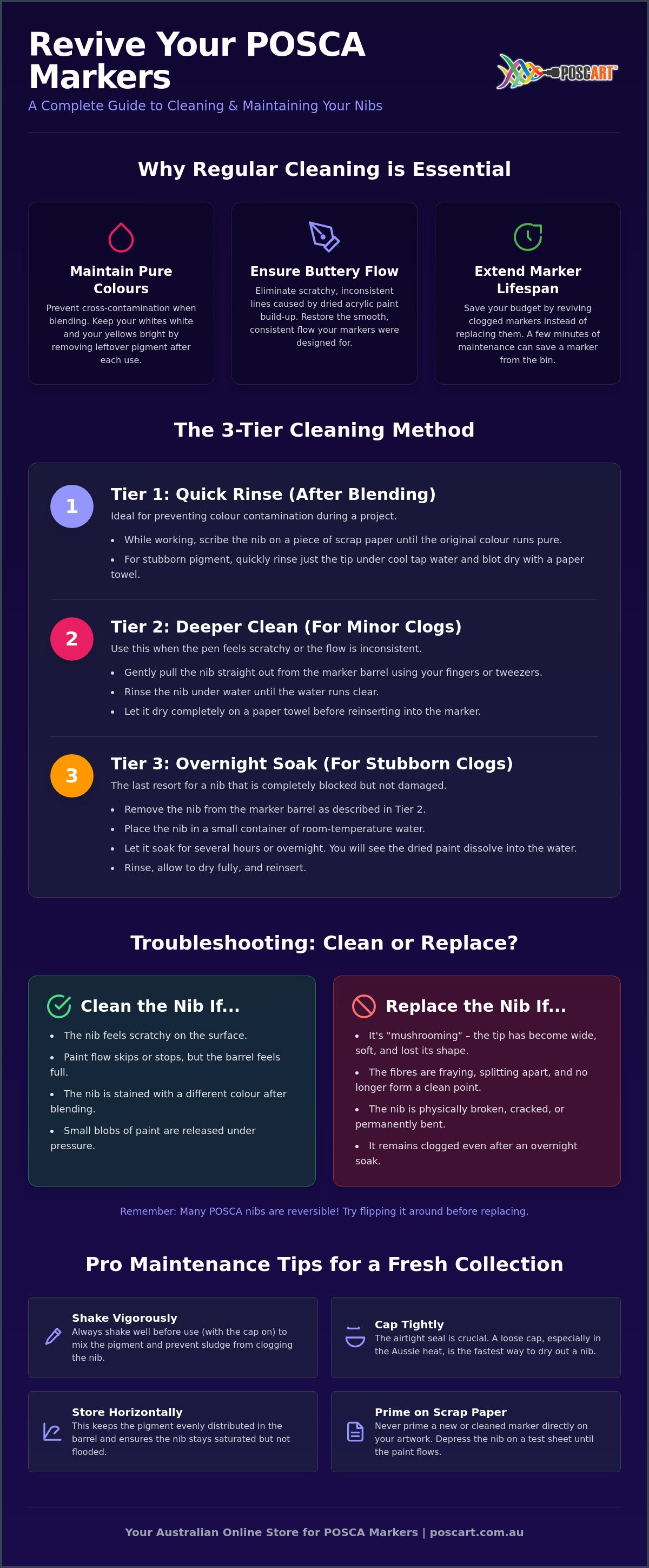
Troubleshooting: When to Clean vs. When to Replace Your Nibs
Even with the best intentions, there comes a point where a nib is simply past its prime. While mastering how to clean posca pen nibs can significantly extend the life of your markers, it's equally important to recognise when a tip has suffered structural damage. A "dirty" nib is usually just clogged with pigment or contaminated with a different colour; a "dead" nib, however, has physically broken down. If you've performed a deep soak and the paint still refuses to flow consistently, it's time to assess the physical state of the polyester fibres.
For most professional artists, a nib should be replaced every few months of heavy use, or immediately if it's been used on highly abrasive surfaces. Most POSCA markers are designed for longevity, but they aren't invincible. The only major exception in the range is the PC-1MR ultra-fine tapered tip. Because this model uses a metal ring to house the tip, the nib isn't replaceable. For all other bullet and chisel models, swapping a worn tip for a fresh one can make your marker feel brand new again.
Identifying a Frayed or Worn-Out Tip
Working on rough, unprimed surfaces like raw timber, stone, or rusty metal acts like sandpaper on your marker. Over time, this friction causes "mushrooming," where the once-sharp point becomes flat and splayed. You might also notice fraying, where individual polyester fibres pull away from the main bundle. This physical breakdown leads to "feathering," where your paint lines look fuzzy and bleed into the surrounding area rather than staying crisp. When you see these visual cues, cleaning won't help. You'll need to visit our Replacement Nibs category to find the correct fit for your specific marker model.
The Limits of Cleaning
Sometimes the problem isn't just the nib, but the paint that has hardened inside the plastic housing. If you've left a marker uncapped in the Australian heat for too long, the acrylic binder can create a permanent plug that water cannot reach. Forcing a clogged marker by pumping it too hard is a common mistake. This puts immense pressure on the internal valve system and can lead to a catastrophic leak or "blob" that ruins your artwork. If a thorough overnight soak doesn't restore the flow, the internal mechanism might be compromised. If you're unsure whether your marker can be saved, ask our expert support team for advice before you attempt any drastic measures.
Remember that permanent staining isn't always a sign of a bad nib. If you've used a light colour over a dark one, the fibres might stay tinted even after a deep clean. As long as the "Flow Test" on scrap paper shows the original colour is coming through pure and opaque, the nib is still perfectly fine to use. Trust your results on the paper more than the visual colour of the dry tip.
Expert Maintenance Tips to Keep Your POSCA Collection Fresh
Mastering the art of maintenance means you'll spend less time worrying about your tools and more time creating. While knowing how to clean posca pen nibs is a vital skill for any artist, your daily habits determine how often you'll actually need to use those rescue techniques. A well-maintained collection starts with proper storage and mindful usage, ensuring your paint markers are always ready for action when inspiration strikes.
Prevention is just as important as the cure. By adopting a few professional habits, you can keep your paint flowing smoothly and avoid the "scratchy" feel that occurs when paint begins to settle. This proactive approach not only saves you money but also ensures that your layering remains consistent and your fine details stay crisp throughout the life of the marker.
Best Practices for Storage and Organisation
The golden rule for any acrylic paint marker is horizontal storage. Storing your pens flat ensures that the internal pigments and binders stay perfectly balanced throughout the barrel. If you store them vertically, the heavy pigments can settle at either the tip or the bottom, leading to watery strokes or immediate clogs. Storing them horizontally keeps the ball bearing in the centre of the barrel, making it much easier to mix the paint during your next session.
Investing in dedicated POSCA marker cases is a smart move for any serious creator. These cases are designed to keep your collection flat while protecting the plastic barrels from the elements. They also allow you to organise your markers by tip size and colour family. This level of organisation prevents the accidental nib damage that often happens when you're rummaging through a cluttered art bin or drawer.
Protecting Nibs During Use
Your choice of surface is the biggest factor in how quickly your nibs wear out. Before you bring your fine or extra-fine tips to a project, take a moment to assess the texture. Rough, porous materials like raw stone or unsealed timber can shred polyester fibres in minutes. We recommend checking our guide on What Surfaces Do POSCA Pens Work On? for specific advice on priming and sealing. By applying a base coat or a simple sealant, you create a smooth runway for your nib, significantly reducing the frequency of clogs.
Finally, don't forget the importance of the "click." Every time you finish a session, ensure the cap is pressed on firmly until you hear that distinctive sound. This airtight seal is your best protection against the Australian heat. It's also worth taking a damp cloth to the inside of your caps occasionally. Dried paint build-up in the cap can easily transfer back to a fresh tip, undoing all your hard work. When you combine these storage habits with the knowledge of how to clean posca pen nibs, you'll find your markers last longer and your colours stay purer than ever before.
Ready for Your Next Creative Project?
If a nib has truly reached the end of its life through fraying or structural damage, swapping it for a fresh tip is a quick way to restore that buttery flow you love. As an authorised POSCA specialist and an Australian family-owned business, we take pride in supporting your creative journey with expert advice and fast national shipping from our Australian centre. If you're ready to refresh your studio or have questions about your markers, browse our full range of genuine POSCA markers and accessories at PoscART. We can't wait to see the incredible work you produce with your refreshed tools.
Frequently Asked Questions
Can I wash POSCA nibs with soap?
No, you should never use soap or detergents to clean your tips. These substances can leave chemical residues that interfere with the acrylic binder, potentially ruining the paint flow and consistency. Stick to lukewarm water for the best results. If water alone isn't shifting the pigment, it's usually a sign that the nib is physically worn rather than just dirty.
How do I get dried POSCA paint out of a nib?
The most effective way to remove dried paint is a deep soak in lukewarm water. If the paint has hardened into the fibres, leave the nib in a small container of water overnight to soften the acrylic binder. You can also hold the nib under a running tap to force out stubborn pigment clusters. This is the core technique for how to clean posca pen nibs that have been left uncapped.
Can you take the nib out of a POSCA pen?
Most POSCA models feature removable tips, including the PC-1M, PC-3M, and PC-5M. You can simply pull the nib straight out with your fingers or a pair of tweezers. However, you cannot remove the tip from the PC-1MR model, as it uses a specialised metal housing. For all other models, removing the nib is the safest way to perform a deep clean without damaging the marker barrel.
Why is my POSCA pen nib scratchy?
A scratchy feel usually indicates dried paint build-up on the surface of the fibres or physical damage from rough surfaces. If cleaning the nib doesn't restore a smooth glide, the polyester fibres may have started to fray or "mushroom." This physical wear is common when working on unprimed timber or stone. In these cases, reversing or replacing the nib is the only way to get back to a professional finish.
How long do I need to soak a POSCA nib to clean it?
For minor colour contamination, a two minute rinse or soak is often enough. If you're dealing with a complete blockage, we recommend soaking the nib for several hours. Leaving it in water overnight is the standard for reviving markers that have been neglected. Always ensure you have a scrap piece of paper ready to test the flow once the nib has dried and been re-primed.
Is it better to clean or replace a stained POSCA nib?
Staining is purely cosmetic and doesn't affect performance if the paint flow is still opaque. If the tip is physically splayed or frayed, cleaning won't help you achieve crisp lines. Replace the nib when you notice "feathering" in your work or if the flow remains watery after a thorough drying. Maintaining a small stash of replacement nibs is a smart move for any professional studio.
What happens if I put a wet nib back into my POSCA pen?
Putting a wet nib back into your marker will result in thin, watery paint that lacks the signature POSCA opacity. The excess water dilutes the acrylic binder and pigment, which can cause your artwork to bleed or look streaky. Always dab the nib on a paper towel and let it air-dry completely before re-inserting it. This ensures your colours stay vibrant and your layering remains consistent.
Do all POSCA markers have reversible nibs?
Not all models feature this design. Reversible nibs are a specific feature of the PC-3M and PC-5M bullet tips. If one side of these tips becomes slightly worn, you can flip it around to reveal a fresh writing surface. For other sizes like the PC-8K chisel or PC-1M extra-fine, the nibs are replaceable but not reversible. Knowing how to clean posca pen nibs and when to flip them can double your marker's lifespan.
General Information
This article is provided as general information only to help customers compare and choose POSCA markers, acrylic markers, art supplies, creative tools and related products. Product details, colours, finishes, surface suitability, availability, pricing and usage results may vary. Always check the individual product page, manufacturer information, age guidance, surface instructions and safety recommendations before purchasing or using a product.