







POSCA Marker 8mm Guide: Mastering the PC-8K Broad Chisel Tip
A large-scale mural should be a bold statement of your creativity, not a frustrating battle against streaky ink and patchy coverage. Many artists find that scaling up their work introduces a fresh set of challenges, especially when trying to maintain consistent flow with a posca marker 8mm broad tip. It is easy to feel overwhelmed when you are staring at a massive surface and your tools aren't performing with the precision you expect. You want your work to look professional, yet the fear of receiving counterfeit markers online often makes the buying process feel like a gamble.
In this guide, you will learn exactly how to master the PC-8K to achieve crisp lettering and smooth, opaque fills on almost any surface. We will help you understand why this specific chisel tip is the preferred choice for architectural lines and vibrant signage. You will also discover how to choose from the 35 available colours to organise your next project with absolute confidence. From surface preparation to layering techniques, this overview provides the practical advice you need to turn your large-scale visions into reality.
Key Takeaways
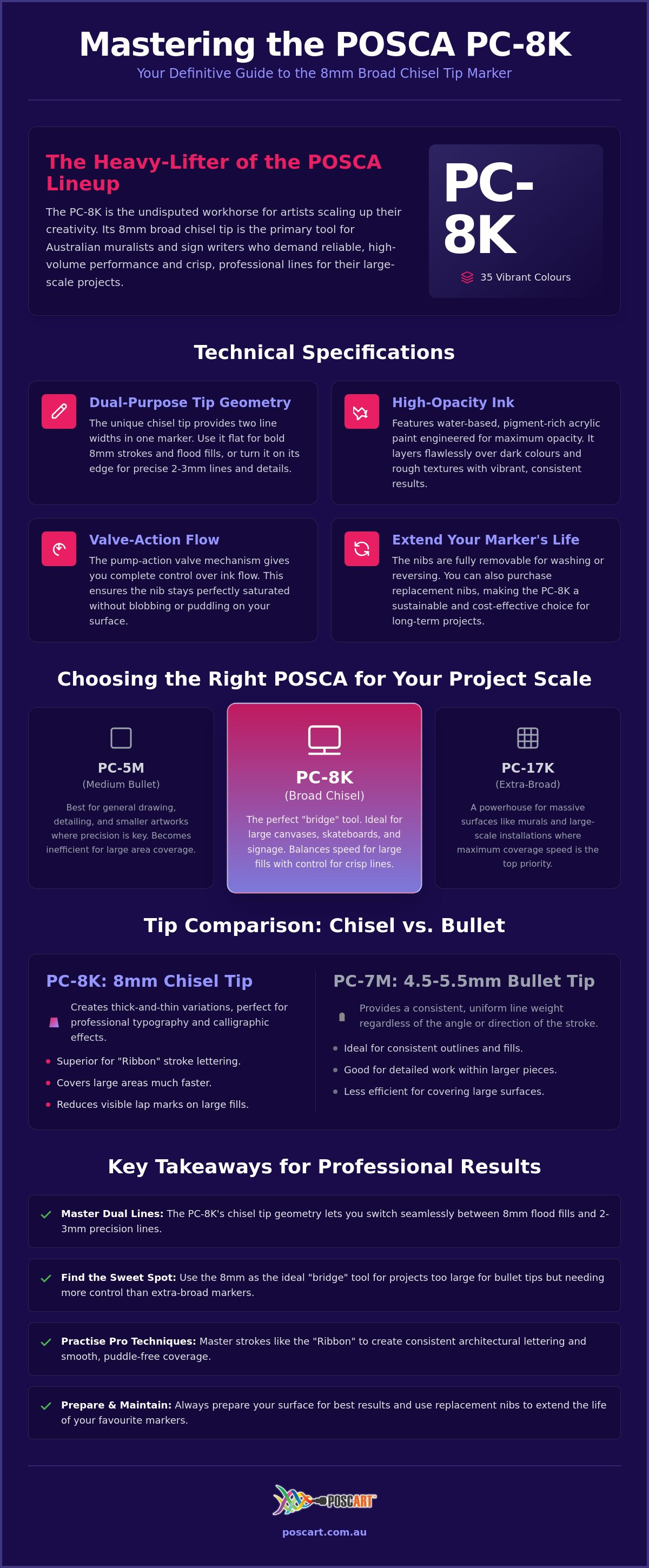
- Learn how the unique geometry of the PC-8K chisel tip allows you to switch seamlessly between 8mm flood fills and 2-3mm precision lines.
- Discover why the posca marker 8mm is the ideal "bridge" tool for projects that are too large for bullet tips but require more control than extra-broad markers.
- Master professional techniques like the "Ribbon" stroke to create consistent architectural lettering and smooth, puddle-free coverage on large canvases.
- Understand the essential preparation steps for various surfaces and how to use replacement nibs to extend the life of your favourite markers.
- Gain confidence in your creative toolkit by learning how to identify authentic supplies and curate a personalised colour palette for murals or signage.
Understanding the POSCA Marker 8mm: The PC-8K Broad Chisel
What truly defines this POSCA paint marker is its water-based, pigment-rich ink. The formula is engineered for maximum opacity, meaning it can layer over dark colours or rough textures with ease. It's this consistency that has turned the PC-8K into a "workhorse" for professionals. You aren't just getting a big marker; you're getting a specialised delivery system for high-quality acrylic paint that remains vibrant long after it dries.
To see exactly how to prime and activate these broad markers for your next project, watch this helpful video:
Technical Specifications of the PC-8K
The geometry of the PC-8K is its greatest asset. The broad chisel tip allows for a full 8mm stroke when used flat, which is perfect for filling large shapes quickly. However, if you tilt the marker to its side, you can achieve a much finer 2-3mm line for outlines or smaller details. This dual-purpose design is supported by a valve-action flow mechanism. By pumping the nib, you regulate the ink flow to ensure the tip stays saturated without "puddling." For those who use their tools heavily, the nibs are both removable and washable. You can even find replacement nibs to extend the life of your marker barrel, making it a cost-effective choice for long-term projects.
Chisel Tip vs. Bullet Tip: Why 8mm Matters
Choosing between the PC-8K chisel and the PC-7M bullet tip depends entirely on your desired aesthetic. While both are considered broad markers, the posca marker 8mm chisel tip is far superior for calligraphic lettering and "ribbon" effects. The flat edge allows you to maintain a consistent angle, creating the thick-and-thin variations essential for professional typography. In contrast, a bullet tip provides a uniform line regardless of the direction. When it comes to speed, the 8K wins for area coverage. It covers ground much faster than smaller medium tips, allowing you to complete large-scale fills without the visible "lap marks" that often occur when ink dries too quickly between strokes.
Choosing the Right POSCA for Your Project Scale
Selecting the correct tool depends on the surface area you need to cover and the level of detail required. While the popular PC-5M medium bullet is fantastic for general drawing, it quickly becomes inefficient when you're working on something the size of a skateboard or a large canvas. If you find yourself spending more time "colouring in" than creating, it's time to step up to the posca marker 8mm. This chisel tip acts as a versatile bridge between detail and speed, allowing you to block out shapes in a fraction of the time it would take with a medium tip.
For artists managing larger commissions, efficiency is everything. You can streamline your workflow by opting for custom POSCA bundles, which allow you to select the exact 8mm shades needed for a specific mural or branding project. Using a broader tip doesn't just save time; it ensures a more even application of paint. This consistency reduces the visible overlapping lines that often occur when you're forced to use smaller nibs for large fills.
PC-8K vs. PC-17K: Finding the Sweet Spot
The PC-17K is a powerhouse with its 15mm extra-broad tip, but it isn't always the right choice for every large job. The posca marker 8mm offers a level of versatility that the 17K lacks. While the 17K is excellent for massive background fills, it can be cumbersome for anything requiring a steady hand or subtle curves. Hand fatigue is a real factor during long creative sessions; the 8K barrel is significantly easier to grip for extended periods, providing better control for architectural lettering and complex shapes. Additionally, the 8K is far more portable. It fits neatly into standard POSCA marker cases, whereas the 17K often requires its own dedicated space in your kit.
Primary Use Cases for the 8mm Tip
Street artists and muralists frequently rely on the 8K for blocking in large characters or geometric patterns. Its ability to create both thick and thin lines makes it indispensable for "cutting in" edges before filling the centre. In the retail world, this marker is a favourite for creating professional, high-contrast window displays. The opaque ink stands out against glass, making it perfect for seasonal promotions or menu boards that need to be readable from a distance.
If you're into DIY, the 8mm chisel is excellent for upcycling furniture. It allows you to apply a smooth, solid coat of colour to flat surfaces like drawer fronts or tabletops without the mess of traditional paint tins and brushes. If you're unsure which tip size will suit your specific surface, feel free to reach out to our creative support team for personalised advice on building your perfect kit.
Mastering Chisel Tip Techniques for Professional Results
Mastering the posca marker 8mm involves more than just pressing it to a surface. Because of its unique chisel shape, the way you orient your hand determines the character of every stroke. Unlike bullet tips that provide a uniform line, the PC-8K rewards deliberate movement and specific angles. Whether you are aiming for architectural precision or expressive street art, understanding these tactical manoeuvres will elevate your finished work from a hobbyist level to a professional standard.
The "Ribbon" technique is perhaps the most essential skill for anyone creating signage. By locking your wrist and maintaining a consistent 45-degree angle to the baseline, you can produce calligraphic lettering with natural thick and thin variations. This creates a rhythmic, professional look that is nearly impossible to replicate with a round tip. Conversely, if you need a razor-thin detail, don't reach for a smaller pen immediately. Simply rotate the marker to use the sharp edge of the chisel. This allows you to "cut in" fine outlines or add highlights while keeping your colour palette perfectly consistent across the project.
When filling large areas, the goal is smooth, opaque coverage without "puddling." If you hold the nib in one spot for too long or pump it excessively while drawing, the paint will pool and create uneven textures. Instead, use long, sweeping strokes and keep the marker moving. If you need to layer a second colour, patience is your best tool. Always wait for the first coat to be completely dry to the touch. Applying a light colour over a wet dark colour will lead to nib contamination, which can muddy your 8mm tip and require a thorough cleaning or a replacement nib to fix.
Activating and Priming Your 8mm Marker
The PC-8K contains a significant volume of paint, making the initial activation process crucial. You must hear the internal ball-bearing rattling clearly; this ensures the heavy pigments are thoroughly mixed with the water-based binder. Shake the marker vigorously for at least 30 seconds before your first use. When pumping the nib on a scrap piece of paper, do so gently. The 8mm nib is large and can hold a lot of paint, so it's easy to flood it by mistake. For a deeper dive into this process, check out our guide on how to activate POSCA markers, which covers the essential valve-action mechanics.
Advanced Blending with Broad Tips
One of the most exciting features of the 8mm chisel is its ability to blend colours directly on the surface. On non-porous materials like glass or plastic, you can practise wet-on-wet blending to create stunning gradients. Use the broad flat surface of the nib to "push" one wet colour into another. This technique is perfect for sunset backgrounds or 3D lettering effects. Just remember to wipe the nib clean on a spare cloth immediately after blending to preserve the purity of your original colour for the next stroke.
Surface Preparation: Getting the Most from Your 8mm POSCA
Preparing your canvas correctly is the secret to a long-lasting finish, especially when working with the high-volume ink flow of a posca marker 8mm. Because the PC-8K is often selected for larger, more ambitious projects, the surface it meets must be ready to receive the paint without causing premature wear to the nib. Different textures respond to the acrylic paint in unique ways. You can find a detailed breakdown of specific materials in our guide on what surfaces POSCA pens work on, but the broad 8mm tip requires some specific handling.
On porous surfaces like raw timber or terracotta, the paint is absorbed quickly. This can lead to "nib drag", where the friction of the rough surface pulls at the felt tip. To manage this, apply a light primer or gesso first to create a smoother path for the marker. This is a common tactic used in rock painting across Australia, where the 8mm tip is the favourite choice for laying down solid base colours on large river stones before adding finer details with smaller markers. For non-porous surfaces like metal or glass, the focus shifts to cleanliness. Any oils from your hands or dust on the surface will prevent the paint from bonding, leading to flaking later on.
Outdoor Murals and Signage
When you're working on shop windows or external walls, the Australian climate becomes a significant factor. Shop windows must be thoroughly degreased with a glass cleaner or a diluted vinegar solution before you start. Heat is another challenge; the posca marker 8mm flow can change during a hot Australian summer. High temperatures can make the ink runnier, increasing the risk of drips. Try to work in the shade or during the cooler parts of the day to maintain a steady flow. Once your mural or sign is finished, sealing it with a UV-resistant varnish is essential to protect the vibrant pigments from the harsh sun.
Customising Surfboards and Skateboards
The 8mm chisel tip is perfect for creating the bold, graphic designs seen on surfboards and skateboards. However, these surfaces are often treated with factory coatings that resist paint. For plastic or fibreglass, you'll need to lightly sand the area with fine-grit sandpaper to create "tooth" for the paint to grab onto. After sanding, apply a plastic-compatible primer. The broad 8mm width allows you to create striking deck designs with fewer strokes, resulting in a cleaner look. To ensure your art survives the waves or the skate park, apply several thin coats of a high-quality clear coat once the paint is fully cured. If you're tackling a complex custom build and need advice on compatible sealants, contact our specialist team for technical support.
Maintenance and Authenticity: Protecting Your Investment
A posca marker 8mm is a significant addition to any artist's toolkit, and proper care ensures it remains a reliable asset for years. Because the PC-8K holds a larger volume of paint than its finer counterparts, the way you store and maintain it directly impacts the consistency of your work. These markers are designed for longevity, but they perform best when treated with the respect a professional tool deserves. By following a few simple maintenance steps, you can avoid common issues like dried nibs or inconsistent ink flow.
Storage is the first step in protecting your investment. You should always store your broad-tip markers horizontally. Storing them vertically can cause the heavy acrylic pigments to settle at the bottom of the barrel or, conversely, flood the nib and cause leaks. Keeping them flat ensures the pigment remains evenly distributed, making the "ball-bearing shake" much more effective when you're ready to start your next session. Authenticity is equally vital. Buying from a specialised Australian POSCA store like PoscART ensures you are receiving genuine Uni-ball products. Counterfeit markers often suffer from poor pigment quality and unreliable valve systems, which can ruin a professional mural or signage project.
Replacing Your 8mm Nibs
The felt nib of the PC-8K is incredibly durable, but rough surfaces like concrete or unprimed timber can eventually cause fraying. If you notice your lines losing their crispness, you don't need to replace the entire marker. First, try pulling the nib out and rinsing it under warm water to remove any dried paint buildup. If the tip is still worn, you can actually flip it around to reveal a fresh, unused edge on the other side. For markers that have reached the end of their nib life, purchasing replacement nibs is a sustainable way to keep your posca marker 8mm barrel in action without the cost of a full replacement.
Building Your Custom 8mm Palette
While sets are a great starting point, many professional artists find that buying individual markers is the best way to support their specific style. The PC-8K range includes 35 vibrant colours, allowing you to double up on essential shades like black, white, and primary tones while skipping colours you rarely use. This personalised approach is perfect for sign writers who need to match a specific brand's colour scheme. If you are tackling a massive project, the Big Job Coverage Set is an excellent choice, providing a curated selection of 24 markers designed specifically for high-coverage mural work. Curating your kit this way ensures you always have the right tool for the scale of your vision.
Take Your Large-Scale Projects to the Next Level
Mastering the PC-8K broad chisel tip opens up a world of creative possibilities for murals, professional signage, and bold DIY projects. By understanding how to manipulate the 8mm edge for both fine lines and flood fills, you can work with a level of efficiency and precision that smaller markers simply cannot match. Remember that the longevity of your posca marker 8mm depends on consistent maintenance, such as horizontal storage and utilising replacement nibs when the felt begins to wear. Proper surface preparation remains the foundation of a professional finish; it ensures your vibrant acrylic pigments bond perfectly to your chosen canvas.
As an authentic POSCA specialist and Australian family-owned business, PoscART is dedicated to supporting your creative journey with genuine supplies and fast national shipping. If you have any questions about choosing the right colours or need technical advice for a specific surface, we are here to help. Contact our specialist support team today to ensure you have the perfect tools for your next big idea. We can't wait to see the bold statements you create with your new favourite broad-tip markers.
Common Questions About the PC-8K
What is the difference between the POSCA PC-8K and PC-7M?
The primary difference lies in the shape of the tip. The PC-8K features a broad chisel tip that allows for varied line widths between 2mm and 8mm depending on the angle you hold it. In contrast, the PC-7M has a large bullet tip that produces a consistent line of approximately 4.5mm to 5.5mm. This makes the 8K superior for calligraphic lettering, while the 7M is better for uniform outlines.
Can I replace the nib on a POSCA 8mm marker?
Yes, the nib on your posca marker 8mm is fully replaceable and washable. You can easily pull the felt nib out to rinse it under warm water if it becomes clogged or simply flip it around to use the fresh internal side. If the nib is too worn from use on rough surfaces, you can purchase specific 8K replacement nib sets to extend the life of your marker barrel.
How long does an 8mm POSCA marker take to dry on wood?
POSCA ink typically dries on wood within 5 to 10 minutes, though this varies based on the timber's absorbency and the local humidity. Because wood is a porous material, the paint bonds quickly as the water-based solvent is absorbed into the grain. It's best to wait at least 20 to 30 minutes before applying a second layer or a clear sealant to ensure the first coat is fully cured.
Are 8mm POSCA markers permanent on surfboards?
They are not naturally permanent on the slick, non-porous resin of a surfboard. To ensure your artwork survives the surf, you must lightly sand the area first to create "tooth" and then apply a specialised clear acrylic spray or resin once the paint is dry. Without this protective sealant, the saltwater and friction from paddling will eventually cause the design to peel or fade away.
How do I fix a dried-out PC-8K chisel tip?
You can often revive a dried PC-8K tip by removing the nib and soaking it in a container of warm water for several hours. If the paint has hardened significantly on the edge, flipping the nib to the internal side often provides a fresh, saturated writing surface. Always remember to shake the marker vigorously to re-engage the internal ball-bearing before pumping the nib to restart the paint flow.
Is the 8mm POSCA marker safe for use in primary school classrooms?
Yes, these markers are water-based and non-toxic, making them safe for supervised activities in primary school environments. However, the posca marker 8mm barrel is quite large for very small hands to grip. They are most effective for collaborative poster projects or large-scale murals where students can work together on flat surfaces to create bold, vibrant displays.
Which POSCA marker size is best for filling in large areas?
The PC-8K and the PC-17K are the most efficient choices for covering significant surface areas. While the 15mm PC-17K covers ground faster, the 8K chisel tip is often considered the most versatile option. It balances speed with the ability to handle corners and curves, making it the preferred choice for most Australian muralists who need both coverage and control.
How do I stop my 8mm POSCA from streaking on glass?
Streaking on glass is usually caused by residual oils on the surface or inconsistent hand pressure. Always degrease the glass with a vinegar-based cleaner or glass spray before you begin your work. When using the 8mm tip, maintain a steady, slow pace and avoid overlapping wet paint with a dry nib, as this tends to "lift" the first layer and create visible streaks.
General Information
This article is provided as general information only to help customers compare and choose POSCA markers, acrylic markers, art supplies, creative tools and related products. Product details, colours, finishes, surface suitability, availability, pricing and usage results may vary. Always check the individual product page, manufacturer information, age guidance, surface instructions and safety recommendations before purchasing or using a product.