







Mastering the POSCA Ultra Fine Tip: The Complete PC-1MR Guide for Australian Artists
Have you ever felt that your detailed illustrations were held back by a marker that just couldn't stay consistent? It's a common hurdle for many Australian creators who find their posca ultra fine tip lines thickening unexpectedly or their nibs catching on the grain of the paper. We understand that in technical drawing and intricate hobby projects, a fraction of a millimetre makes all the difference.
This guide will help you master the PC-1MR ultra-fine paint marker so you can achieve the professional, crisp outlines your work deserves. You'll learn exactly how this metal-ringed technical tool differs from the standard PC-1M and how to keep it from clogging on your favourite surfaces. We'll walk through proper care techniques and surface preparation to ensure your markers last longer and your finishes look sharper. Whether you're a student or a professional designer, you'll gain the confidence to choose and use the right tip for every detail.
Key Takeaways
- Learn why the 0.7mm metal-encased tip is the essential choice for technical illustrators who require a perfectly calibrated line that never spreads.
- Clear up the confusion between the rigid PC-1MR and the flexible PC-1M to help you choose the right tool for your specific creative style.
- Practise proper activation and the "Light Touch" technique to keep your posca ultra fine tip flowing smoothly without damaging the delicate nib on rougher surfaces.
- Gain the skills to layer crisp, opaque details over dark colours, ensuring your finishing touches stand out with professional clarity.
- Understand the importance of sourcing genuine supplies to maintain consistent ink quality and longevity across your entire marker collection.
What is a POSCA Ultra Fine Tip? Precision Engineering for Detail
The posca ultra fine tip, specifically the PC-1MR model, represents a significant shift from standard creative markers. Unlike traditional bullet tips, the PC-1MR features a 0.7mm pin-style tip that provides a "calibrated" line. This means the stroke remains exactly the same width from the moment the nib touches the paper until you lift it. This level of precision is a hallmark of the Mitsubishi Pencil Company, the creators of the POSCA range, who have spent decades refining technical writing instruments.
Australian graphic designers and technical illustrators rely on this consistency for intricate linework where a standard felt tip might bleed or spread. Because the ink is a water-based pigment rather than a dye, it sits on top of the surface, offering an opacity that standard fineliners simply cannot match. It's the go-to tool for centring a design or adding those final, microscopic details that bring a piece to life.
To better understand this concept, watch this helpful video:
The Anatomy of the PC-1MR Metal Tip
The most striking feature of the PC-1MR is its metal-encased tip. This ringed sleeve protects the delicate 0.7mm nib, preventing it from splaying or losing its shape under pressure. Inside the barrel, a specialised valve system manages the flow of the pigment-rich ink. You'll still need to give your marker a good shake to mix the paint, but the valve ensures the delivery is controlled and steady. This design makes the posca ultra fine tip surprisingly durable on various textures, including smooth cardstock or even prepared stone.
Who is the Ultra Fine Tip For?
This tool bridges the gap between technical drafting and fine art, making it a staple in many Australian studios. It serves a variety of creative needs:
- Creative professionals: Adding high-contrast highlights to roughs or defining edges in architectural sketches.
- Hobbyists: Perfect for the precision required in scrapbooking, card making, and the intricate patterns of mandala art.
- Fine artists: Indispensable for adding a final "sparkle" to a large canvas or signing their work with a clean, legible script.
The Technical Edge: Why the PC-1MR is the King of Detail
Achieving a crisp, professional outline is often the hardest part of any illustration. While standard felt tips tend to "feather" or spread as the ink hits the paper, the posca ultra fine tip on the PC-1MR is designed to resist this capillary action. The metal ring around the nib acts as a stabiliser, ensuring that the 0.7mm stroke stays exactly 0.7mm. This is what professionals call a "calibrated" line. It provides a level of predictability that's essential when you're working on the final stages of a complex piece.
The secret lies in the unique formulation of the ink. Unlike dye-based pens that soak into the fibres, POSCA uses a highly opaque pigment. This is supported by scientific research on acrylic polymers, which explains how these binders create a durable, non-absorbent film on the surface. This allows the ultra-fine tip to cover dark backgrounds or previous layers with a single pass, which is almost unheard of for a marker this small.
Handling the PC-1MR feels more like using a technical drawing pen than a traditional paint marker. The barrel is significantly slimmer than its larger siblings, offering superior ergonomics for long sketching sessions. In Australia, you can find this model in 22 specialised shades, ranging from classic metallics to vibrant primary colours, giving you a full palette for high-detail work.
Consistency is Key
One major frustration with fine-tip paint pens is the "paint dump" that happens when the internal valve releases too much pressure. The PC-1MR's calibrated system prevents this, maintaining uniform line weights that are critical for architectural drawing. It's also the go-to choice for fine lettering and calligraphy outlines where shaky or inconsistent flow would ruin the elegance of the script.
Layering with the Ultra Fine Tip
Because the posca ultra fine tip applies a thinner layer of paint than a broad marker, the drying speed is remarkably fast. This makes it perfect for adding pinpoint white highlights over PC-5M layers without having to wait half an hour between steps. To avoid "lifting" the underlying paint, use a light touch; the 0.7mm scale requires very little pressure to achieve a solid, opaque mark.
If you're unsure which colour set will best suit your next project, feel free to reach out to our creative support team for personalised advice.
PC-1MR vs PC-1M: Which Extra Fine POSCA Should You Choose?
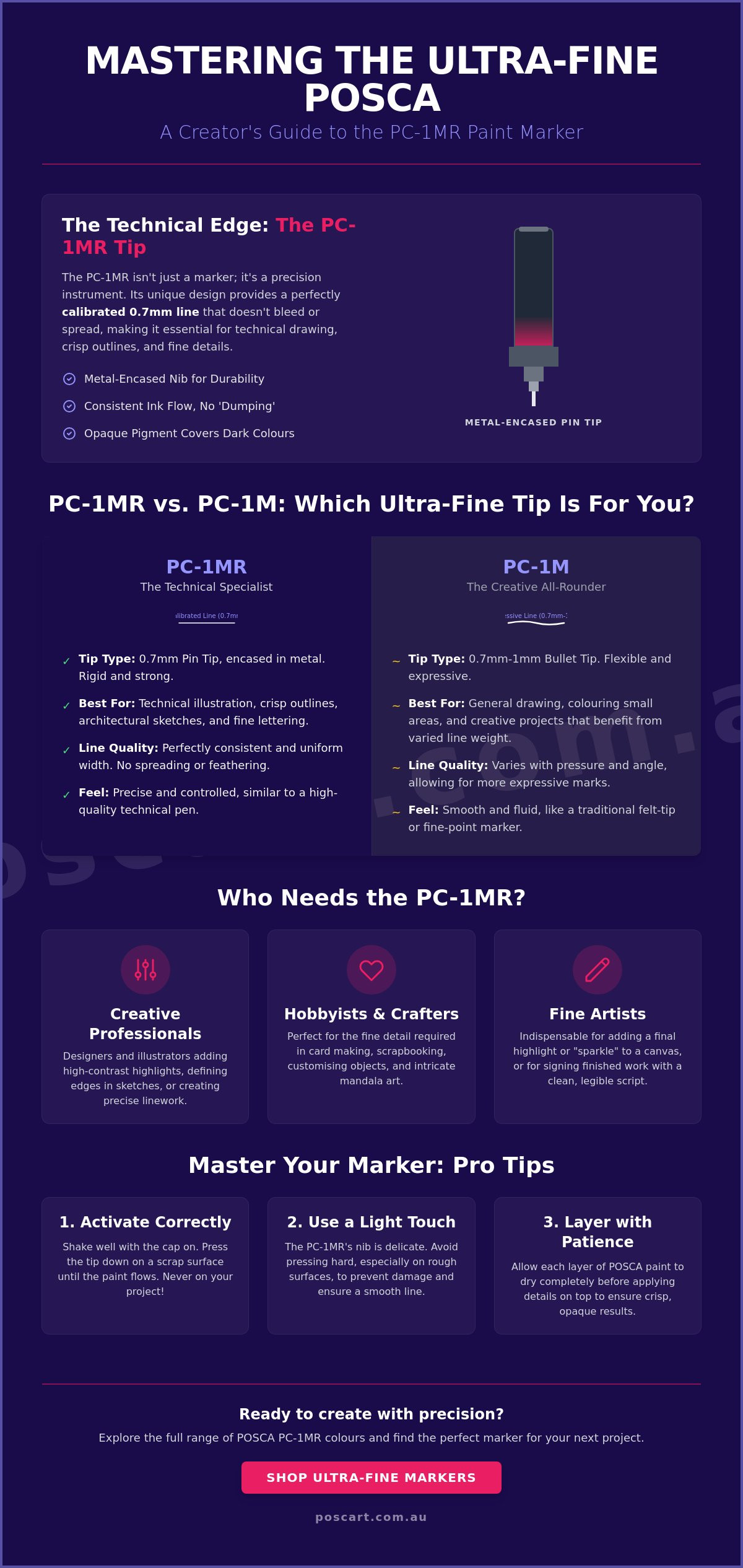
It's a common dilemma for Australian artists standing in front of an art supply shelf. Both markers are labelled as 0.7mm, yet they look and feel completely different. The distinction lies in the nib construction. The PC-1MR uses a metal-encased pin tip, while the PC-1M features a more traditional plastic bullet nib. Understanding these physical differences is the first step in choosing the right posca ultra fine tip for your specific project.
The PC-1MR is built for rigidity. Because the nib is held firmly within a metal sleeve, it doesn't flex, regardless of how much pressure you apply. This makes it a "calibrated" tool, ideal for when you need a line that never wavers. In contrast, the PC-1M has a plastic nib that offers a tiny amount of "give." While it is still an extra-fine marker, a heavy-handed artist can produce a slightly thicker stroke with the PC-1M compared to the unwavering PC-1MR. Light-handed artists often prefer the pin-point accuracy of the metal-ringed version.
The way the ink interacts with the surface also changes based on the nib material. When we look at the properties of acrylic paint, we see that it's a fast-drying emulsion of plastic. The metal tip of the PC-1MR glides over non-porous surfaces like glass or acetate without catching. However, on rougher watercolour paper, that same metal tip might feel "scratchy" or pick up paper fibres. This is where the plastic bullet of the PC-1M shines, as it's far more forgiving on textured materials.
When to Choose the PC-1MR (Ultra Fine)
If your work involves technical drawing, architectural sketches, or microscopic outlines, the PC-1MR is your best friend. It excels on smooth surfaces where a fixed line width is non-negotiable. It's the perfect choice for detailing treated plastic models or adding fine script to glass ornaments. You can browse our full range of individual PC-1MR colours to find the exact shade for your technical needs.
When to Choose the PC-1M (Extra Fine)
The PC-1M is a versatile choice for small colouring tasks and detailed illustrations on standard paper. Because the plastic nib is softer, it feels more natural for beginners who are still learning to control their hand pressure. One major advantage for the budget-conscious artist is that you can easily swap out a worn PC-1M nib with a fresh one. The PC-1MR, due to its metal casing, does not have a replaceable nib, so it requires a more delicate touch to ensure longevity.
Mastering the Fine Line: Creative Techniques and Maintenance
Proper activation of the posca ultra fine tip is a delicate balancing act. Unlike the broader models, the PC-1MR requires a gentler approach to get the paint moving. Start by shaking the marker thoroughly with the cap on to hear the internal ball rattle and mix the pigment. Instead of pumping the nib aggressively on your work surface, press it lightly onto a scrap piece of paper. The metal capillary is narrow, and the paint takes a moment to travel down the sleeve. Over-priming can lead to a pool of paint, which is exactly what you want to avoid when you're aiming for high-detail precision.
Once the flow is established, you should practise the "Light Touch" technique. While the metal sleeve is incredibly sturdy, using too much pressure on textured surfaces can cause the nib to catch or spray microscopic splatters. For shading, the 0.7mm tip is an exceptional tool for stippling and cross-hatching. These techniques allow you to build up depth and shadow without losing the crispness of your base colours. It's a method that provides much more control than traditional blending when you're working at a microscopic scale.
Australian Project Inspiration
Australian artists find endless uses for this level of precision in their local projects. A favourite hobby is detailing "Kindness Rocks." Using smooth river stones as a canvas, the PC-1MR allows you to add tiny, intricate patterns or meaningful quotes that remain perfectly legible. For those working on larger equipment like surfboards, this ultra-fine marker is the ideal tool for pinstriping and adding decorative borders over broad base layers. You can also personalise your tech gear, such as phone cases and laptops, with custom illustrations that won't smudge once the acrylic film has set.
Unclogging and Nib Care
Maintenance is where many creators get tripped up, as the metal tip behaves differently than porous nibs. Because the posca ultra fine tip has a metal sleeve, it can collect dust or dried paint build-up around the rim. Use a slightly damp, lint-free cloth to wipe the metal tip after each session to prevent blockages. If the flow stops completely, you can try the "soaking" trick: dip only the very end of the metal tip into a small amount of warm water for a few minutes to loosen any dried pigment inside the capillary.
Storage is just as vital as cleaning. Always store your markers horizontally. This position ensures the pigment remains evenly distributed throughout the barrel and prevents the heavy particles from settling at the bottom or clogging the valve. If you've tried these maintenance steps and your marker still isn't performing, contact our creative support team for expert troubleshooting and advice.
Organising Your Fine Tip Collection with PoscART
Sourcing genuine markers is the foundation of any professional toolkit. In Australia, the climate and shipping conditions can significantly affect the longevity of acrylic markers, which is why choosing a specialist supplier matters. When you invest in a posca ultra fine tip, you're buying a precision instrument. Using counterfeit or poorly stored markers often leads to inconsistent ink flow and ruined work. At PoscART, we prioritise the integrity of our stock, ensuring every PC-1MR and PC-1M arrives in peak condition, ready for your most intricate designs.
Building your collection takes time. Don't rush it. We understand that a well-organised studio leads to a better creative flow. By choosing authentic products, you ensure that the pigment remains vibrant and the internal valve system functions exactly as intended. This reliability is what allows you to focus on the art rather than fighting with your tools.
Creating the Perfect Detail Bundle
Choosing between individual pens and curated fine-tip sets depends on your current project needs. While many artists start with individual pens to fill specific gaps, others prefer the value and balanced palette found in a set. Every detail kit should include the "Big Four" essentials: Black for crisp outlines, White for pinpoint highlights, and Gold and Silver for professional metallic accents. To ensure these tools last, investing in proper marker storage is vital. Keeping your posca ultra fine tip markers horizontal protects the delicate metal capillaries from drying out or becoming clogged with settled pigment.
Specialist Support for Australian Creatives
PoscART is more than just an online shop; we're an Australian family-owned business deeply invested in the local creative community. We take pride in being a knowledgeable mentor for our customers. We understand the unique challenges of working with acrylic markers on varied surfaces, from local river stones to professional canvases. Using authentic POSCA products is non-negotiable for those seeking archival-quality results that won't fade or crack over time.
If you're ready to take your detailed artwork to the next level but aren't sure which nib size or colour range best suits your style, we're here to help. Reach out to our team for personalised guidance! We're committed to providing a safe, professional, and inspiring environment for every Australian artist, hobbyist, and student.
Elevate Your Detail with Precision Calibration
Mastering the posca ultra fine tip opens up a world of technical possibilities for your creative projects. Whether you're pinstriping a surfboard or adding microscopic highlights to a portrait, the PC-1MR provides the unwavering consistency that professionals demand. You now understand the vital difference between the rigid metal-encased tip and the flexible plastic bullet of the PC-1M, ensuring you always reach for the right tool for the job. By practising the light touch technique and maintaining your markers with horizontal storage, you'll enjoy long-lasting performance and crisp, opaque lines every time.
PoscART is here to support your creative journey with specialised Australian POSCA expertise and a 100% authentic product guarantee. As an Australian family-owned store, we provide fast national shipping to ensure your supplies arrive exactly when inspiration strikes. Our team is dedicated to helping you find the perfect instruments for your specific artistic needs, from technical drafting to fine art signatures.
Contact our creative team at PoscART for help choosing your perfect ultra-fine markers!
We can't wait to see the incredible detail and professional finish you bring to your next masterpiece. Happy creating!
Frequently Asked Questions
What is the difference between the POSCA PC-1MR and PC-1M?
The main difference lies in the nib construction and barrel design. The PC-1MR features a 0.7mm pin-style tip encased in a metal ring, which provides a rigid, calibrated line. In contrast, the PC-1M has a plastic bullet-shaped tip that offers more flex under pressure. While both are considered extra-fine, the PC-1MR has a slimmer barrel, making it feel more like a technical drawing pen than a traditional paint marker.
How do I stop my POSCA ultra-fine tip from clogging?
To prevent your posca ultra fine tip from clogging, always wipe the metal sleeve with a damp, lint-free cloth after use. This removes any microscopic paint build-up before it dries around the rim. Storing your markers horizontally is also essential, as it keeps the pigment evenly distributed. If the flow feels restricted, a quick shake with the cap on usually redistributes the paint particles and clears the internal valve system.
Can you replace the nib on a PC-1MR ultra-fine marker?
No, the nib on a PC-1MR cannot be replaced because it is built into the metal casing. This differs from the PC-1M, which has a removable plastic nib. Because the PC-1MR nib is fixed, it requires a lighter touch during use to ensure the metal sleeve doesn't become damaged or bent. If your PC-1MR stops flowing, try soaking the metal tip in warm water rather than attempting to pull it out.
Is the POSCA ultra-fine tip permanent on all surfaces?
POSCA paint is naturally permanent on porous surfaces like paper, wood, and unglazed terracotta. On non-porous materials such as glass, plastic, or metal, the paint is water-resistant once dry but can be removed with a scraper or cleaning agent. For professional results on these smooth surfaces, we recommend applying a water-based clear varnish. This extra layer protects your fine details from wear and tear, especially on frequently handled items like phone cases.
What is the best way to store PC-1MR markers to prevent drying?
Horizontal storage is the only way to keep your PC-1MR markers in peak condition. Storing them vertically, either tip-up or tip-down, causes the heavy pigment to settle at one end, which leads to either a watery stroke or a clogged valve. By keeping them flat, the paint remains perfectly mixed. This ensures that the 0.7mm stroke stays opaque and consistent every time you start a new creative project.
How long does it take for the ultra-fine paint to dry?
The paint from a posca ultra fine tip typically dries within 1 to 2 minutes on most surfaces. Because the 0.7mm nib applies a very thin layer of paint compared to broader tips, the moisture evaporates much faster. However, drying times can vary depending on the humidity and the absorbency of your material. It's always best to wait a full 5 minutes before layering another colour over the top to avoid any potential smudging.
Can I use the PC-1MR for rock painting and mandalas?
Yes, the PC-1MR is an exceptional tool for rock painting and intricate mandalas. Its calibrated 0.7mm line allows you to draw microscopic patterns and tiny dots that larger markers simply can't achieve. While it works beautifully on smooth river stones, be careful on rougher rocks. The metal tip can catch on jagged textures, so we recommend using a light hand or prepping your stone with a smooth base coat first.
Why is my ultra-fine POSCA leaking or scratching the paper?
Leaking usually occurs if you've primed the marker too aggressively, causing the valve to stay open. Scratching is often a result of using a metal-tipped marker on paper with a heavy grain or using too much downward pressure. The PC-1MR is designed for a "light touch" approach. If you find it's catching, try switching to a smoother paper or reducing the angle at which you hold the pen to ensure the metal sleeve glides easily.
General Information
This article is provided as general information only to help customers compare and choose POSCA markers, acrylic markers, art supplies, creative tools and related products. Product details, colours, finishes, surface suitability, availability, pricing and usage results may vary. Always check the individual product page, manufacturer information, age guidance, surface instructions and safety recommendations before purchasing or using a product.