







Mastering POSCA MOP'R Techniques: A Guide to Drips, Splashes, and Bold Coverage
The POSCA MOP'R PCM-22 isn't just a larger marker; it's a gravity-fed paint delivery system that requires a unique balance of pressure, angle, and surface knowledge. You likely chose this tool for its high-impact potential, but soon realised that mastering posca mop'r techniques involves more than just a quick squeeze. It's common to feel frustrated when ink floods your canvas unexpectedly or those iconic drips stop short of your creative vision. Our team of creative specialists knows that the jump from precision tips to this bold, fluid format can feel like a steep learning curve.
We're here to help you harness that power to create professional-grade drips, stamps, and large-scale effects that truly pop. This guide provides the practical advice you need to achieve consistent flow, protect your foam tip on rougher surfaces, and perfectly layer your work with finer POSCA tips. You'll gain the confidence to turn messy accidents into intentional, street-art-inspired masterpieces while ensuring your colours stay vibrant and your drying times remain manageable. Let's dive into the fluid world of the MOP'R and elevate your creative toolkit.
Key Takeaways
- Understand how the unique 'grenade' ergonomic shape and 3-19mm round nib provide precise squeeze-control for bold, large-scale projects.
- Master essential posca mop'r techniques including professional drips, splashes, and stamps by balancing pressure, angle, and speed.
- Discover the 'Wet-on-Wet' blending window to create seamless colour transitions and achieve fast coverage on expansive canvases.
- Learn to prepare porous surfaces correctly to manage the high ink volume of the MOP'R and prevent unwanted bleeding or smudging.
- Ensure consistent paint flow and fresh ink quality by sourcing genuine products from a specialist Australian retailer like PoscART.
What is the POSCA MOP'R PCM-22?
The POSCA MOP'R PCM-22 represents a significant shift in how artists approach fluid acrylics. Unlike the standard bullet or chisel tips you might be used to, the MOP'R is an XXL-sized marker featuring a substantial 3mm to 19mm round foam rubber nib. This isn't just a larger version of a classic pen; it's a completely different delivery system. Manufactured by the Mitsubishi Pencil Company, these POSCA paint markers utilise a water-based, non-toxic pigment that is famous for its opacity and lightfastness across over 50 different surfaces.
What sets this marker apart is the high-volume ink delivery. Standard valve-action markers rely on a pumping motion to prime the nib, but the MOP'R uses a gravity-fed, squeezable barrel. This design allows you to flood a surface with paint far more quickly than any other marker in the range. It's become a staple for street art, large-scale gallery canvases, and creating deeply expressive textures that traditional tools simply can't replicate. Whether you're working on a mural or a custom skateboard, the MOP'R provides a level of coverage that saves time while adding a raw, energetic aesthetic to your work.
The Ergonomics of Fluid Art
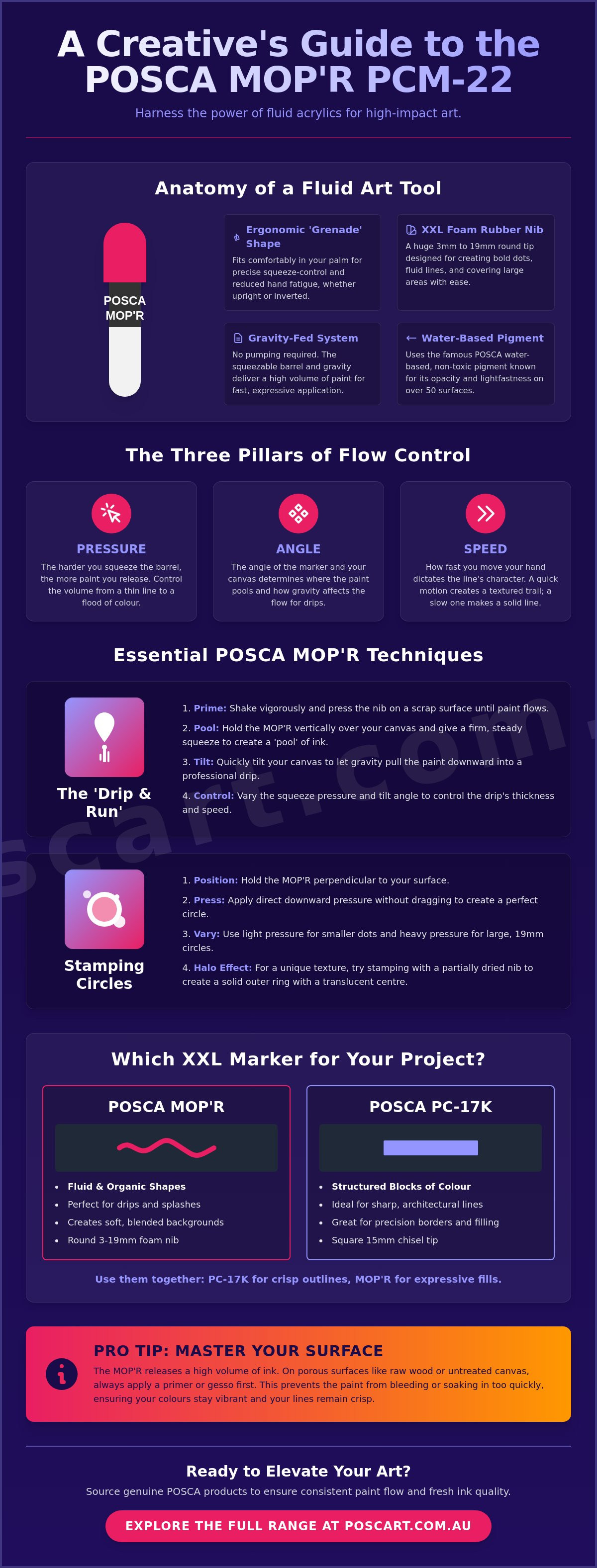
The unique "grenade" shape is more than just a stylistic choice. Its rounded, ergonomic barrel is designed to fit comfortably in the palm, allowing for both upright and inverted use. This versatility is essential for various posca mop'r techniques, such as creating vertical drips or controlled splashes. By gently squeezing the barrel, you regulate the paint flow with precision. This tactile control is a game-changer for artists who suffer from hand fatigue, as it requires less downward pressure than traditional markers. It's an intuitive way to manage fluid art without the mess of traditional brushes and pots. For creators who enjoy the tactical feel of such high-performance tools, Utah Paintball Supply provides gear that similarly prioritises grip and effective paint delivery.
MOP'R vs PC-17K: Which for Large Areas?
When you're staring at a massive blank space, you might wonder whether to reach for the MOP'R or the extra-broad POSCA Broad Tip Markers like the PC-17K. The choice comes down to the finish you want to achieve. The PC-17K features a 15mm chisel tip that is perfect for structured, flat blocks of colour and sharp architectural lines. In contrast, the MOP'R's foam nib is built for fluid flow and organic shapes. If your project requires "running" drips or soft, blended backgrounds, the MOP'R is your best bet. Use the 17K for precision borders and the MOP'R for the expressive, high-impact filling in between.
Essential POSCA MOP'R Techniques: Drips, Stamps, and Splashes
To truly master posca mop'r techniques, you have to start with a vigorous shake. You'll hear the ball bearing inside mixing that thick acrylic pigment to the perfect consistency. Once you're ready, press the nib onto a piece of scrap cardboard. Listen for a distinct, soft 'hiss' as the air escapes and the paint saturates the foam. This sound tells you the tip is primed and ready for action. Finding the 'sweet spot' is a matter of trial and error; always keep a bit of waste material nearby to test your flow before touching your final masterpiece.
Success with the MOP'R rests on three pillars: pressure, angle, and speed. Unlike a standard pen, your hand becomes the pump. The harder you squeeze the 'grenade' barrel, the more paint you release. The angle determines where that paint pools, while your movement speed dictates whether you get a solid line or a textured trail. Balancing these three elements allows you to transition from a precise stamp to a wild, running drip in a single motion.
The Signature 'Drip and Run' Technique
Creating the perfect vertical drip is a hallmark of the MOP'R. First, hold the marker vertically with the nib facing down. Apply a firm, steady squeeze to create a 'pool' of ink on your surface. Once the pool is established, tilt your canvas or board quickly to let gravity pull the paint downward. Learning these drip painting techniques helps you understand how gravity interacts with fluid media. You can vary the squeeze pressure to control exactly how thick or fast that drip travels down your work.
Stamping and Perfect Circles
The 19mm round foam tip is essentially a high-capacity stamp. By pressing the nib directly down without dragging, you can create perfectly uniform dots and circles. You can control the diameter of these shapes by varying the pressure you apply to the nib. If you want a 'halo' effect, try stamping with a partially dried nib. This leaves a solid outer ring with a weathered, translucent centre. It's an excellent way to add rhythmic patterns or celestial details to your backgrounds.
Splatter and Splash Effects
For more chaotic energy, the MOP'R excels at splatter. By flicking the marker toward your surface with a sharp, controlled motion, you create expressive paint bursts. Alternatively, try a sharp squeeze while moving your entire arm across the canvas to produce long 'splash' lines. These methods can be messy, so we recommend using a drop cloth or working outdoors where possible. If you're unsure which colour palette suits your next mural, our creative support team is always happy to help you select the right tones for refining your posca mop'r techniques.
Large Scale Coverage and Fluid Blending
One of the most impressive posca mop'r techniques is its ability to transform a massive blank canvas into a saturated, vibrant background in minutes. While the PC-17K is excellent for structured blocks, the MOP'R delivers a much higher volume of paint, making it the superior choice for sheer speed. Because the foam nib is porous and wide, it holds a significant reservoir of ink that flows out with minimal pressure. If you're tackling a mural or a wide-format board, The Big Job Coverage Set provides the variety of tools needed to cover ground quickly without exhausting your markers.
Timing is everything when working with such large amounts of fluid acrylic. You need to be aware of the 'Wet-on-Wet' blending window, which is the short period before the paint begins to skin over. If you wait too long, you'll experience 'foam drag'. This happens when the nib catches on partially dried paint, pulling up clumps and creating an uneven texture. To maintain a professional finish, keep your movements fluid and your ink supply consistent by giving the barrel a gentle squeeze every few strokes.
Filling Big Areas Without Streaks
To achieve total opacity on canvas without visible lines, work in steady circular motions. This keeps the paint edge 'wet' and active, allowing new ink to meld seamlessly with the previous stroke. We recommend overlapping each pass by approximately 50%. This ensures that no thin patches are left behind. Be mindful of the environment; the Australian heat can cause the ink to dry significantly faster than in cooler climates. Working in the shade or in a temperature-controlled space will give you more time to perfect your coverage before the paint sets.
Blending Colours with the MOP'R
Blending with a MOP'R is far more intuitive than with finer tips because of the volume of paint involved. Apply two different colours side-by-side while they are both still wet. You can then use a clean MOP'R nib or even a specialised art brush to swirl the transition zone where the two colours meet. This creates a soft gradient that is difficult to achieve with standard markers. Once you've finished blending, always scribble on a piece of scrap paper until the nib runs clear. This prevents permanent contamination of your marker's original colour, ensuring it's ready for your next project.
Integrating Different Marker Sizes
A common mistake is thinking the MOP'R must work alone. You can achieve incredible depth by using the MOP'R for your base layer and then refining the piece with finer markers. For instance, wait for your MOP'R background to dry completely before adding sharp outlines with a PC-5M or intricate details with a PC-3M. Alternatively, you can draw into the wet MOP'R ink with a finer tip to create 'bleeding' highlights. This mix of scales adds a professional level of complexity to your artwork that single-size markers can't match.
Mastering Surfaces: Preparation and Protection
The sheer volume of ink delivered by the MOP'R is its greatest strength, but it also presents the biggest challenge for surface management. While a standard PC-5M deposits a controlled, thin layer of paint, the MOP'R functions more like a reservoir. It can easily deposit five to ten times more ink in a single stroke depending on your squeeze pressure. This high-volume delivery means that posca mop'r techniques require a different approach to preparation than your average paint pen. If you don't account for this fluid power, you risk ink bleeding through your substrate or pooling in ways that obscure your detail.
Before you start your next big project, run through this readiness checklist to ensure your surface can handle the load. First, ensure the area is completely free of dust and oils; a quick wipe with a lint-free cloth is essential. Second, if you are working on something upright, ensure your drop cloths are positioned well beyond the immediate work zone. Third, always perform a small test patch in an inconspicuous area. For a deep dive into how various materials react to these markers, check out our guide on What Surfaces Do POSCA Pens Work On? to avoid any costly mistakes.
Porous vs Non-Porous Surface Reactions
Your choice of material dictates how the MOP'R ink behaves the moment it hits the surface. On porous materials like raw timber or cotton canvas, expect high levels of absorption. The ink will sink into the fibres, which often results in a more matte finish. You might find that a second coat is necessary to achieve the punchy, opaque look POSCA is known for. Conversely, on non-porous surfaces like glass, metal, or plastic, the ink sits entirely on top. Drips will run much faster and further on these slick materials because there is no friction to slow them down. If you're working on paper, stick to heavy-weight cardstock or watercolour paper of at least 300gsm. Anything lighter will likely warp or pill under the weight of the fluid delivery.
Sealing Your MOP'R Masterpiece
Protection is the final step in mastering posca mop'r techniques. Because the ink layer is significantly thicker than a standard marker, drying times are much longer. You must wait at least 24 hours before even thinking about applying a varnish. If the centre of a thick drip is still slightly damp, a brush-on sealer will smear the pigment across your work, ruining your clean lines. We generally recommend a water-based spray varnish for the first two coats. This sets the ink without physical contact. Once those mist coats have dried, you can follow up with a more robust brush-on sealant if your project requires extra durability. If you're unsure about the best sealant for a specific Australian climate or surface, contact our specialist team for personalised advice on finishing your work.
Elevate Your Art with PoscART’s Authentic Range
Mastering the advanced posca mop'r techniques we've explored requires more than just practice; it demands the right tools. The fluid power of the PCM-22 relies on the specific viscosity of genuine POSCA paint to function correctly. If you're using old or counterfeit markers, you'll likely find the ink either too thick to squeeze or too thin to hold a crisp drip. By choosing a specialist Australian retailer like PoscART, you ensure that every marker in your kit is a genuine, high-quality instrument designed for professional creative outcomes. We take pride in being a trusted local resource for artists who refuse to compromise on their supplies.
Building a full palette of MOP'R colours can be a significant investment for any creator. To make this more accessible, we offer Custom POSCA Bundles that allow you to curate your own selection of tones. Whether you're focused on a monochromatic street-art style or a vibrant, multi-coloured mural, these sets provide the flexibility to buy exactly what you need. This tailored approach ensures you aren't paying for colours that stay at the bottom of your marker case, giving you more freedom to experiment with bold coverage and expressive splashes.
Why Freshness Matters for MOP'R Ink
The squeeze-flow mechanism of the MOP'R is sensitive to the age of the paint. Over time, acrylic pigment can begin to thicken if not stored correctly or if the stock has been sitting in a warehouse for years. This thickening leads to a clogged foam nib and inconsistent drips. At PoscART, our commitment to high-turnover, authentic Japanese-made stock means your ink arrives fresh and ready for fluid work. To keep your markers in peak condition, always store them horizontally in a cool, dry place. This prevents the pigment from settling at one end and ensures the foam tip doesn't dry out between your creative sessions.
Get Personalised Advice for Your Project
Every artist's journey is unique, and sometimes you need specific guidance that a general guide can't provide. Our support team operates as your 'Creative Mentors', bringing deep industry knowledge to every conversation. Whether you're unsure how a specific MOP'R colour will react on a particular Australian timber or you need advice on the best sealer for an outdoor installation, we're here to help. We believe in supporting our community beyond the checkout, ensuring you have the confidence to push the boundaries of your craft. If you're ready to take your work to the next level, Contact our team for expert POSCA guidance today. We're excited to see what you create with the unique power of the POSCA MOP'R.
Take Your Fluid Art to the Next Level
As your specialist Australian POSCA retailer, PoscART provides only genuine Japanese-made markers to ensure your creative flow remains uninterrupted. We provide national shipping across Australia, making it easy to access fresh stock that performs exactly as it should for your specific project needs. Ready to start your MOP'R project? Contact our creative team for advice on the best sets for your needs! We're excited to see how you push the boundaries of your next bold, street-art-inspired creation.
Frequently Asked Questions
How do I make my POSCA MOP'R drip properly?
To make your POSCA MOP'R drip properly, hold the marker vertically with the nib facing downwards and apply a steady squeeze to create a paint pool. Once a sufficient amount of ink has gathered, tilt your surface quickly to let gravity pull the drip. Mastering these posca mop'r techniques requires a bit of trial on scrap cardboard to find the right balance of pressure and tilt speed for your specific surface.
Can I refill the POSCA MOP'R PCM-22?
You cannot officially refill the POSCA MOP'R PCM-22 as Uni-ball does not sell official refill ink for this range. While some artists experiment with their own mixtures, doing so can compromise the specific viscosity required for the squeeze-flow mechanism to work. It's best to replace the marker once the ink is depleted to ensure you maintain a consistent, professional-grade flow and prevent the foam nib from clogging with non-standard pigments.
How long does it take for MOP'R ink to dry completely?
MOP'R ink typically feels dry to the touch within a few minutes, but you should wait at least 24 hours for it to dry completely. Because the MOP'R deposits a much thicker layer of paint than a bullet tip, the core of a drip can remain damp even when the surface looks set. Waiting a full day is essential if you plan to apply a sealer; otherwise, you risk smearing the wet pigment across your artwork.
Is the foam tip on the MOP'R replaceable if it gets damaged?
The foam rubber tip on the MOP'R is not replaceable, so it's important to treat it with care during your creative sessions. Unlike the PC-5M or PC-3M which have replacement nibs available, the MOP'R is a single-unit design. To protect the tip, avoid using it on extremely abrasive or jagged surfaces that might tear the foam. If the tip becomes slightly dry, you can often revive it by gently dabbing it on a damp cloth.
Why is my MOP'R leaking or flooding the canvas?
Your MOP'R may be flooding if you apply too much pressure to the barrel or if there are significant changes in air temperature. Unlike valve-action markers, the MOP'R is gravity-fed and highly sensitive to your grip. If you notice unwanted flooding, ease off the squeeze and try holding the marker at a slight angle rather than perfectly vertical. Always prime the nib on scrap paper first to release any built-up air before touching your canvas.
Can I use the MOP'R on fabric or t-shirts?
You can use the MOP'R on fabric and t-shirts, but be prepared for high levels of ink absorption. The fluid nature of the paint means it will spread more on cotton than on primed canvas or wood. To make your design permanent on fabric, allow the ink to dry for 24 hours and then iron it on the reverse side without steam. This heat-setting process ensures your creative work survives the wash and stays vibrant.
How should I store my MOP'R markers to keep them fresh?
Store your MOP'R markers horizontally to keep the ink well-mixed and prevent the foam tip from drying out prematurely. This orientation ensures the pigment doesn't settle at the bottom of the barrel, making it easier to prime the marker when you're ready to create. Ensure the cap is clicked on tightly after every use. Proper storage is one of the most important posca mop'r techniques for extending the life of your fresh ink stock.
What is the difference between the MOP'R and a regular POSCA marker?
The primary difference lies in the delivery system and the tip size. While regular POSCA markers use a valve-action pump and felt nibs, the MOP'R features a squeezable 'grenade' barrel and a 19mm foam rubber tip. This allows for much higher ink volume and a more fluid, gravity-led application. It's designed for expressive splashes and broad coverage rather than the precision lines you get from traditional bullet or chisel tips.
General Information
This article is provided as general information only to help customers compare and choose POSCA markers, acrylic markers, art supplies, creative tools and related products. Product details, colours, finishes, surface suitability, availability, pricing and usage results may vary. Always check the individual product page, manufacturer information, age guidance, surface instructions and safety recommendations before purchasing or using a product.