


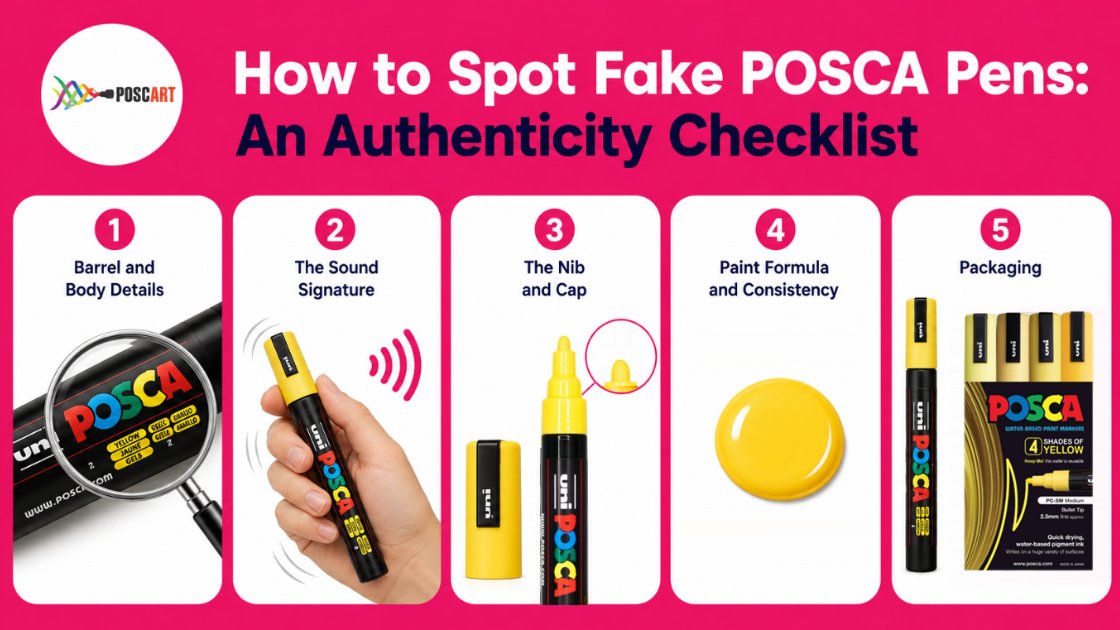
Imagine spending three days meticulously detailing a custom surfboard, only for your "brand new" marker to suddenly dump a puddle of watery ink across your hard work. It's a heartbreaking reality for many Australian creators who've unknowingly picked up a bargain that's just too good to be true. Knowing how to spot fake posca pens is no longer just about saving a few dollars; it's about protecting your creative flow and ensuring your tools perform exactly when you need them to. Your art deserves better. We agree that there's nothing more frustrating than a nib that won't prime or a colour that skips when you're right in the middle of a masterpiece.
This ultimate 2026 authenticity checklist gives you the confidence to identify genuine Mitsubishi Pencil Co. engineering every time you shop. We'll walk you through a clear list of physical red flags, from the specific rattle of the internal mixing ball to the precise batch numbers that should be printed on every barrel. You'll discover how to check for authentic nib quality and where to source 100% genuine POSCA markers within Australia. By the end of this guide, you'll have the expert knowledge needed to keep your kit professional and your projects safe from poor quality counterfeits.
Key Takeaways
- Examine the barrel for official "Uni" branding and Mitsubishi Pencil Co. markings to ensure your markers are genuine Japanese-made tools.
- Recognise the difference between "Grey Market" imports with Japanese text and actual fakes so you can shop for your favourite colours with confidence.
- Discover how to spot fake posca pens by testing the priming speed and ink flow of the nib during your first creative session.
- Perform a simple opacity check on dark surfaces to verify the vibrant, high-pigment finish expected from authentic acrylic paint markers.
- Identify authorised Australian specialists to avoid the environmental and safety risks associated with unregulated counterfeit inks.
The Risk of Counterfeit Paint Markers in Australia
POSCA markers have become the gold standard for Australian creators, from professional muralists to students in the classroom. This immense popularity has unfortunately triggered a wave of counterfeit products entering the local market through various digital channels. In the 2024-25 financial year, Australian Border Force seized over 700,000 counterfeit items with an estimated value of over $35 million. Because art supplies are part of this growing trend, understanding how to spot fake posca pens is the best way to protect your investment and your artwork. The Australian government even introduced the Customs Legislation Amendment Bill in March 2026 to help combat this influx of illicit imports.
Using a knock-off isn't just about dealing with a "cheap" pen. These unregulated markers often contain inks that haven't passed the strict safety and environmental standards maintained by the Mitsubishi Pencil Company. Authentic POSCA ink is water-based, non-toxic, and odourless. In contrast, fakes can emit harsh chemical smells or leak uncontrollably. This creates a massive risk for your projects. Imagine a marker suddenly dumping a puddle of ink onto a half-finished canvas or a pair of custom-painted sneakers. The frustration is compounded by the fact that knock-off nibs are rarely replaceable, meaning a single clog renders the whole pen useless.
To better understand the performance gap between real and imitation markers, watch this helpful video:
Common Sources of Fake POSCA Pens
Various third-party marketplaces and auction sites are frequent hotspots for counterfeiters. While these platforms host legitimate sellers, they also feature "too good to be true" listings where prices are significantly lower than the Australian market average. Be particularly wary of social media "clearance" ads on platforms like Instagram or TikTok. These often use stolen product imagery to sell low-quality imitations that arrive in flimsy packaging. These fake pens often lack the signature internal mixing ball that produces the iconic clicking sound when shaken.
Why Authenticity Matters for Your Art
The real value of a genuine marker lies in its pigment quality and lightfastness. Authentic markers use high-grade pigment that stays vibrant for years, whereas fake pens often rely on cheap dyes that fade quickly when exposed to the Australian sun. Genuine POSCA pens allow for incredible layering and blending; you can paint a light colour over a dark one with total opacity. For professional results and long-term project consistency, investing in genuine individual POSCA pens ensures that every stroke meets the high standards your creative vision requires. Authentic tools don't just work better, they provide the peace of mind that your art will last.
Physical Signs of a Genuine POSCA Marker
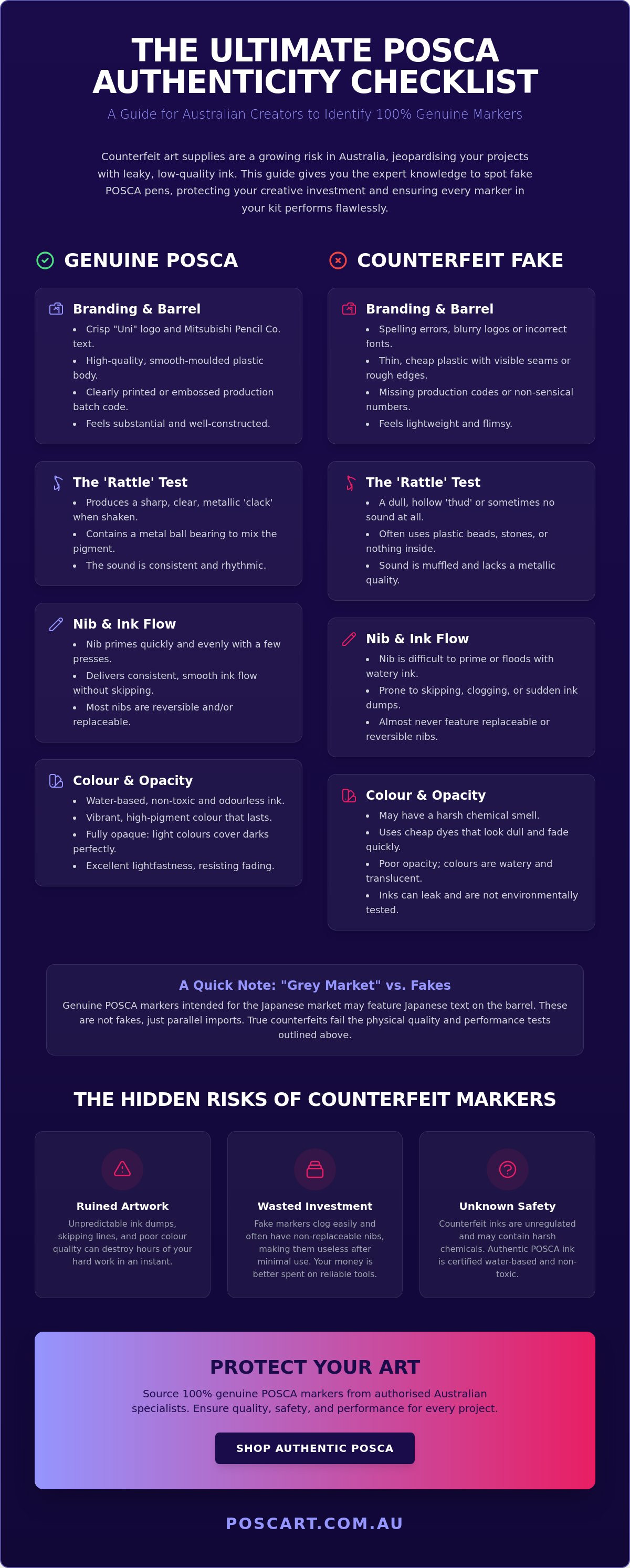
Identifying an authentic marker begins long before you touch the nib to a canvas. Genuine POSCA markers are precision-engineered tools manufactured by the Mitsubishi Pencil Company in Japan. Every component, from the barrel to the internal mixing ball, reflects a high standard of industrial design. When you are learning how to spot fake posca pens, your first step should be a close inspection of the barrel construction. Authentic markers use high-quality, smooth-moulded plastic that feels substantial in your hand. Fakes often use thinner, cheaper plastics that may have visible seams or rough edges from poor manufacturing moulds.
One of the most reliable indicators is the "Rattle Test". Every genuine POSCA contains a metal ball bearing designed to mix the pigment ink thoroughly. When you shake the marker, it should produce a sharp, rhythmic metallic "clack". Counterfeit versions frequently use plastic agitators or even small stones, resulting in a duller, hollow thud. This internal ball is essential for maintaining the consistency of the paint; without it, the ink will likely skip or appear watery. Additionally, look for the batch code. Genuine markers have a small production number embossed or printed clearly on the barrel, usually near the cap or the base. If this code is missing or looks like a blurry inkjet print, it is a major red flag.
The Logo and Typography Check
Counterfeiters often struggle to replicate the precise typography used by the Mitsubishi Pencil Company. On a genuine marker, the "Uni POSCA" branding is crisp, with no bleeding or blurred edges in the print. Check the spelling carefully. It sounds simple, but many low-quality fakes actually misspell the brand name or the technical descriptors. Pay close attention to the alignment of the "Water-Based" and "Pigment Ink" text blocks. On an authentic pen, these are perfectly horizontal and centred within their designated sections. If the text looks slightly tilted or the font weight seems too thin or too chunky compared to your other markers, it is likely a knock-off.
Tactile and Auditory Indicators
The physical experience of handling the pen tells a story. A genuine cap is designed to snap firmly into place with a distinctive "click", creating an airtight seal to prevent the paint from drying out. The plastic of the cap and the end plug should be a perfect colour match to the ink inside. Fakes often have slight variations in these plastic colours. There is also a noticeable weight factor; because of the metal mixing ball and the density of the high-pigment ink, a real POSCA feels slightly heavier than a counterfeit. If you are ever in doubt about the authenticity of a marker you have purchased elsewhere, you can reach out to our specialised support team for a professional opinion.
Decoding Packaging: Japanese vs International Versions
One of the most common points of confusion for Australian artists occurs when their new set of markers arrives covered in Japanese characters. It is a frequent misconception that foreign text equals a counterfeit product. In reality, many authentic POSCA markers sold in Australia are "Grey Market" imports. These are genuine tools manufactured by the Mitsubishi Pencil Company for the Japanese domestic market but sold globally through various retailers. Understanding the subtle differences between these regional variations is a vital step in learning how to spot fake posca pens before you even open the cap.
The primary way to verify these versions is through barcode validation. Every legitimate marker or set features a specific EAN (European Article Number) or UPC (Universal Product Code) that should scan directly to a Mitsubishi Pencil Company product. Counterfeiters often use generic barcodes that either don't scan at all or lead to unrelated products. Additionally, pay close attention to the plastic heat-shrink wrap. Genuine sets use a sophisticated heat-shrink method that is tight, uniform, and features a clean perforated line for easy opening. Fakes often arrive in loose, crinkly plastic that looks like it was applied with a handheld hair dryer; this lack of industrial precision is a clear warning sign.
Identifying Genuine Japanese Imports
Authentic Japanese boxes are often more detailed than their international counterparts. You should see the "Uni" logo displayed prominently alongside the POSCA branding. These boxes feature high-quality instructional diagrams with crisp, clear illustrations showing how to prime the marker. You might also notice that the colour names differ slightly; for example, "Light Blue" in Australia might be labelled as "Mizu" (Water) on a Japanese import. As long as the print quality is sharp and the Mitsubishi Pencil Company branding is present, the language on the box is not a cause for concern. These markers contain the exact same high-pigment, water-based ink as those in English-language packaging.
Packaging Red Flags
Counterfeit sets are usually betrayed by the quality of their housing. Authentic boxes are made from sturdy, high-grade cardboard designed to protect the markers during transit. If your bulk set arrives in a flimsy box with visible glue marks or misaligned stickers, it is likely a knock-off. Fakes often use generic labels that look like they were printed on a home inkjet printer, resulting in slightly fuzzy text and washed-out colours. Another massive red flag is the absence of a batch code on the outer packaging. Genuine Mitsubishi products are tracked with rigorous quality control; if the box lacks these identifiers or features a barcode that looks like a simple sticker applied by hand, the contents are almost certainly not authentic.
The Performance Test: How to Spot a Fake by Using It
Once you have inspected the exterior, the ultimate way to confirm authenticity is by putting the pen to work. The priming process is your first real clue. A genuine POSCA nib is designed to be depressed against a surface to draw ink into the tip. This should happen smoothly and predictably. In a genuine marker, the ink saturates the nib evenly from the centre outwards. If you are struggling with how to spot fake posca pens during this stage, look for uneven soaking or "flooding" where ink pours out of the sides of the nib rather than through the tip itself. A real marker will never dump a puddle of paint during the initial pump.
The smell test is another immediate indicator of quality. Authentic POSCA ink is a water-based pigment formula that is virtually odourless. This makes it a favourite choice for use in classrooms or small home studios. If you open a marker and are met with a sharp, solvent-like chemical smell, you are likely holding a counterfeit. These fakes often use cheaper alcohol-based dyes or low-grade industrial pigments that can be harmful if used in enclosed spaces. Genuine ink is designed to be safe and pleasant to use for artists of all ages.
Nib Quality and Compatibility
The texture of the nib itself provides a tactile signature of quality. Genuine nibs are made from a firm, porous material that holds its shape even under pressure. They should feel smooth on the page, not "scratchy" or like hard plastic. A major advantage of the authentic design is that genuine markers allow for replacement nibs to be inserted easily if the original becomes worn or clogged. Fakes usually have fixed nibs that are prone to "blobbing" or suddenly starving the tip of ink during a single, long stroke. This inconsistency can ruin a project in seconds.
Ink Behaviour on Different Surfaces
Authentic POSCA ink is famous for its "One-Coat" promise. When you apply it to a dark surface like black card or a primed stone, the colour should appear vibrant and opaque almost immediately. It sits on top of the surface rather than soaking in like a dye. This unique behaviour allows for professional layering; once dry, you can paint a light colour directly over a dark one without the bottom layer bleeding through. Perform a "Rub Test" on a scrap piece of material once the ink is dry. Genuine ink dries to a beautiful matte finish that is quite durable. In contrast, counterfeit ink often remains slightly tacky, smears easily, or flakes off the surface like dried mud. If your markers are failing these basic performance benchmarks, get in touch with our creative support team to discuss sourcing genuine supplies.
Ensuring Your Creative Tools are Genuine
After mastering how to spot fake posca pens through physical and performance testing, the final step is securing a reliable supply chain. In the Australian market, the safest way to avoid disappointment is to purchase from dedicated retailers who specialise in art supplies rather than general discount warehouses. These specialists have a direct interest in the creative community and often hold "Authorised Dealer" status, which means their stock comes directly from the Mitsubishi Pencil Company distribution network. This expertise in how to spot fake posca pens ensures your toolkit remains professional and reliable for every project.
Where to Buy Genuine POSCA in Australia
Choosing a local specialist over a massive international aggregator provides a level of accountability you simply won't find on overseas marketplaces. Australian stores understand our local climate and the specific needs of our artists, offering tailored advice on everything from drying times in high humidity to the best sealants for outdoor murals. While it might be tempting to buy a massive bulk set from an unverified seller, building your collection with POSCA marker sets from a trusted source ensures every single pen is the real deal. You can also easily replace your most-used colours with individual markers to maintain consistency in your work. For a deeper dive into selecting the right vendor, check out our buying guide for genuine markers.
Reporting and Handling Counterfeits
If you suspect you have already purchased a counterfeit set, do not use them on professional commissions or expensive surfaces like custom sneakers. The risk of ink failure or surface damage is too high. Instead, contact the seller immediately to request a refund, citing the specific physical red flags you have identified. If they refuse, report the listing to the platform and consider notifying the Australian Competition and Consumer Commission (ACCC) or Crime Stoppers. This helps protect the wider creative community from similar scams and keeps the Australian market clean of sub-standard products.
To keep your shopping experience stress-free, use this final 30-second checklist before you buy:
- Branding: Look for the crisp "Uni" logo and the Mitsubishi Pencil Company name on the barrel.
- The Rattle: Shake the pen; it must have a sharp, metallic "clack" from the internal ball bearing.
- Batch Codes: Check for a small production number embossed or printed near the cap.
- Price: If the price is 50% lower than the standard Australian retail rate, it is likely a knock-off.
- Ink Quality: Authentic ink is opaque, virtually odourless, and dries to a smooth matte finish.
By following these steps, you can invest in your passion with total confidence. Your art is an expression of your hard work and creativity, and it deserve the high-quality, reliable tools that only genuine POSCA markers can provide.
Invest in Your Art with Authentic Supplies
Protecting your creative projects starts with choosing the right supplies. You now have the ultimate checklist for how to spot fake posca pens, from identifying the sharp metallic rattle of the internal mixing ball to verifying the crisp typography on the barrel. By focusing on these physical indicators and testing the ink for its signature matte, opaque finish, you ensure that every stroke on your canvas or sneaker project is professional and permanent. Using genuine tools means your work won't fade or flake, giving you the results your hard work deserves.
PoscART is proud to be an Authorised Australian Stockist, providing a safe and reliable environment for artists across the country. We maintain an extensive range of individual pens and custom bundles, all dispatched with fast national shipping from our Australian centre. Whether you are a student or a professional designer, we're here to support your creative journey with 100% genuine tools. If you have any questions about our range or need help selecting the perfect tip size for your next piece, please Shop 100% Genuine POSCA Markers at PoscART Australia. We can't wait to see the vibrant masterpieces you create with your authentic supplies.
Frequently Asked Questions
Is it a fake if the pen says "Uni" instead of "POSCA"?
No, both names should appear on the barrel because Uni-ball is the parent brand manufactured by the Mitsubishi Pencil Company. You will typically see the stylised "U" logo alongside the POSCA product name on every genuine marker. Seeing the "Uni" branding is actually a mark of authenticity; it confirms the tool was produced by the original manufacturer in Japan.
Why are some POSCA pens so much cheaper on auction sites and marketplaces?
Extremely low prices on unverified third-party marketplaces are usually the first warning sign of counterfeit art supplies. While some sellers offer genuine "Grey Market" imports at a slight discount, prices that are significantly lower than the Australian retail average often indicate unregulated fakes. These sellers avoid the costs of quality testing and genuine pigment, passing those performance risks directly onto your artwork. Understanding how to spot fake posca pens helps you avoid these risky bargains.
Can I use replacement nibs in a counterfeit POSCA pen?
Genuine replacement nibs are unlikely to fit into a counterfeit marker due to differences in industrial moulding and barrel tolerances. Authentic markers are engineered with specific dimensions that allow you to swap out tips as they wear or become clogged. Fakes are produced with non-standardised parts, meaning you cannot easily repair them or maintain them for long-term use.
Do fake POSCA pens have a different smell than the real ones?
Yes, a sharp chemical or solvent odour is a major red flag for a counterfeit pen. Genuine POSCA ink is water-based and virtually odourless, making it safe for use in classrooms and small home studios. If your markers smell like permanent markers or alcohol, they likely contain unregulated inks that could bleed through your paper or damage your creative surfaces.
What should I do if I accidentally bought fake POSCA markers?
You should immediately stop using the markers on your professional projects and contact the seller for a full refund. Report the fraudulent listing to the platform and provide photos of the physical red flags you have identified. Learning how to spot fake posca pens helps you build a stronger case for a refund while protecting other Australian artists from making the same mistake.
Are the POSCA pens with Japanese writing on them authentic?
Most markers with Japanese text are authentic products intended for the Japanese domestic market. These imports contain the same high-quality pigment ink as the international versions found in Australian stores. As long as the Uni branding and batch codes are present, the presence of Japanese characters on the barrel is not a sign of a counterfeit product. These tools are simply regional variations manufactured by the same parent company.
Does the rattle sound in a POSCA pen prove it is real?
The presence of a rattle isn't definitive proof, but the sharp metallic "clack" of the internal ball bearing is a strong indicator of quality. Genuine markers use a metal mixing ball to ensure the high-pigment ink is perfectly blended before use. Many fakes use plastic agitators or small stones that produce a duller, hollow sound that doesn't mix the ink as effectively.
Will fake POSCA pens ruin my artwork over time?
Counterfeit markers can cause long-term damage due to poor lightfastness and unstable chemical formulas. Fake inks often fade rapidly when exposed to the Australian sun or react poorly with sealants and varnishes. Using genuine tools is the only way to ensure your colours stay vibrant and your investment in art supplies is protected for years to come.
General Information
This article is provided as general information only to help customers compare and choose POSCA markers, acrylic markers, art supplies, creative tools and related products. Product details, colours, finishes, surface suitability, availability, pricing and usage results may vary. Always check the individual product page, manufacturer information, age guidance, surface instructions and safety recommendations before purchasing or using a product.