







Bullet Tip Paint Markers: The Australian Artist’s Guide to Precision and Flow
Have you ever reached the final details of a project only to have a scratchy, inconsistent nib ruin your hard work? It's incredibly frustrating when cheap generic pens fail to deliver the smooth, opaque flow your art deserves. Most Australian artists have felt that sting, but the secret to crisp lines and reliable performance often comes down to choosing the right specialised tools.
We're here to help you master bullet tip paint markers by exploring the precision engineering of authentic POSCA markers. You'll discover how to decode the different sizes, from the extra-fine PC-1M to the bold PC-7M, ensuring you never feel confused by a size chart again. We'll also share professional tips on maintaining and swapping nibs to keep your markers performing like new. By the end of this guide, you'll have the confidence to select the perfect PoscART bundle to bring your creative vision to life with total control.
Key Takeaways
- Understand why the symmetrical design of bullet tip paint markers ensures a consistent line width and reliable ink flow across different angles.
- Learn how to select the ideal POSCA size for your work, matching models like the PC-1M or PC-3M to your specific detail and coverage requirements.
- Practise the essential four-step activation technique to prime your markers correctly and achieve a perfectly opaque finish on any surface.
- Gain the skills to clean and maintain your nibs effectively, preventing clogs and ensuring your favourite tools last through multiple creative projects.
Why Bullet Tip Paint Markers are the All-Rounders of the Art World
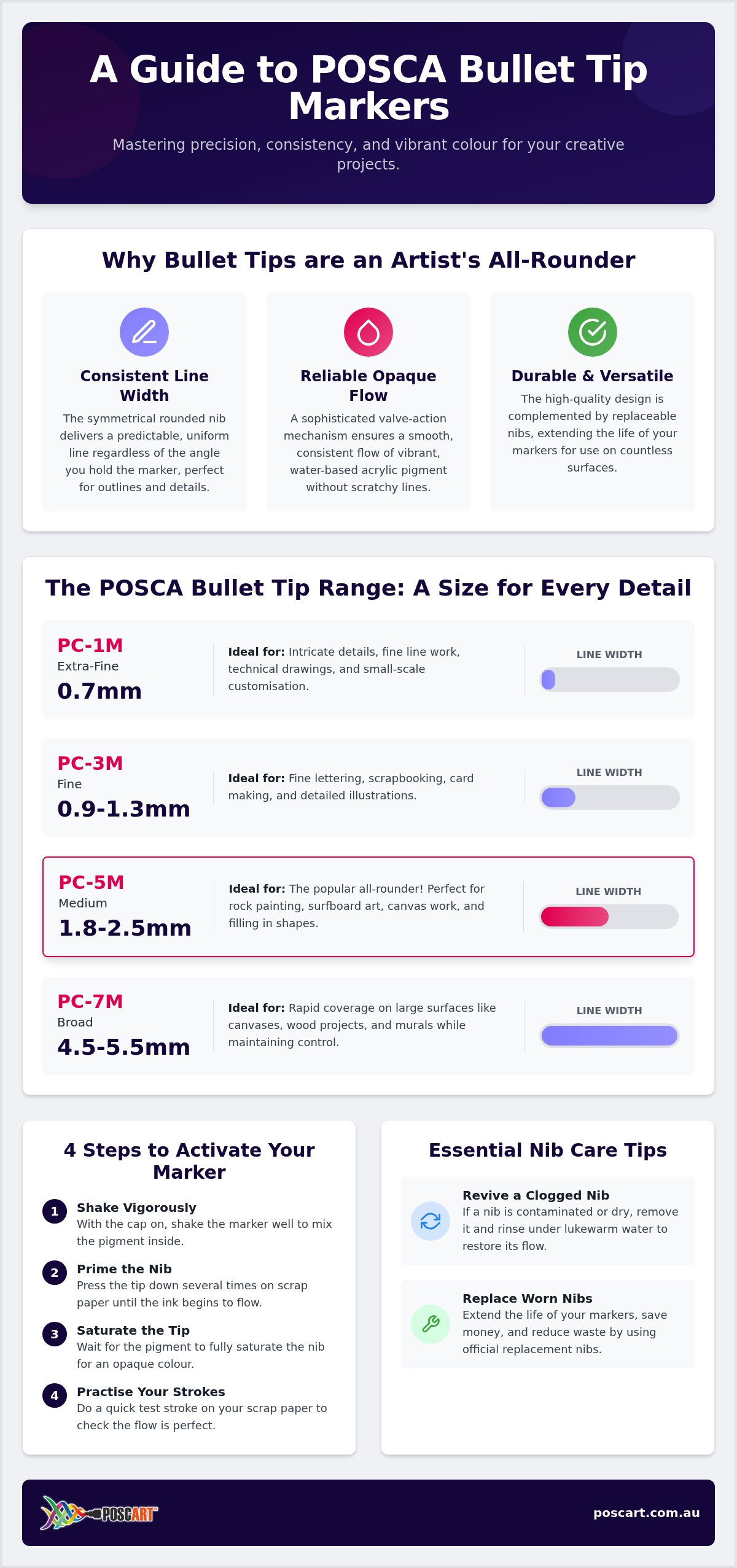
Choosing the right tool transforms your creative process. A bullet tip is a symmetrical, rounded nib designed to provide a consistent line width, regardless of the angle at which you hold the pen. Unlike other shapes that require specific hand positioning, these tips offer a level of predictability essential for technical work. A Paint marker with this design allows you to focus entirely on the artwork rather than managing the tool's orientation.
Inside every POSCA marker is a sophisticated valve-action mechanism. This engineering ensures the water-based acrylic pigment remains fluid and opaque, which prevents the dry, scratchy lines often found in cheap alternatives. It feels as natural to hold as a standard ballpoint pen, yet it delivers the intense vibrance of acrylic paint. For Australian creators, this makes bullet tip paint markers the most reliable choice for sketching, detailing, and final highlights.
PoscART stocks the full range of POSCA markers because they represent the gold standard in durability. The high-quality pigment is complemented by the availability of replacement nibs, which means you can refresh your marker if the tip becomes worn or contaminated over time.
Bullet vs. Chisel and Brush Tips: Finding Your Creative Flow
While chisel tips create calligraphic edges and brush tips offer variable pressure-sensitive strokes, the bullet tip remains steady. This consistency makes them the preferred choice for beginner outlines, uniform colouring-in, and detailed dot-work. Even for large-scale projects, a broader bullet tip like the PC-7M provides excellent control. It allows for bold, sweeping movements on murals while maintaining a clean, predictable edge that is easier to manage on textured surfaces than a chisel tip.
The POSCA Bullet Tip Range: From Fine Detail to Bold Coverage
POSCA offers a comprehensive lineup of bullet tip paint markers tailored for every stage of your project. The PC-1M Extra-Fine tip provides a precise 0.7mm line, perfect for technical drawings and the intricate details that bring a piece to life. It's the go-to choice for artists working on small-scale customisations or fine jewellery pieces where every millimetre counts.
The PC-3M (Fine) and PC-5M (Medium) are the heavy lifters of the range. The PC-5M Medium Bullet Tip is arguably the most popular "all-rounder" in Australia, favoured for everything from rock painting to surfboard art due to its versatile 1.8 to 2.5mm line. All genuine POSCA markers conform to international safety and labeling standards, which confirms they are water-based and suitable for various creative environments, including classrooms.
For those needing to fill larger areas without losing the predictability of a rounded nib, the PC-7M Broad tip offers a generous 4.5 to 5.5mm line. It allows for rapid coverage on canvases or wood projects while maintaining the control you'd expect from a standard marker. If you're tackling massive murals, you might even consider large-scale artwork sets to ensure you have the volume of paint required for the job.
Choosing Between the PC-3M and PC-5M for Your Project
Selecting the right size depends on the scale of your canvas. The PC-3M produces a 0.9 to 1.3mm line, making it ideal for fine lettering and delicate scrapbooking patterns. In contrast, the PC-5M creates a bolder stroke that is better for vibrant illustrations and filling in shapes. You'll find that combining these sizes in POSCA marker sets provides a complete creative toolkit for any project. If you're still deciding which sizes will best suit your style, you can explore our artist guides for more detailed tips.
Surface Mastery and Nib Care: Getting the Most from Your Bullet Tips
To achieve a flawless flow with your bullet tip paint markers, correct activation is essential. At PoscART, we recommend a simple four-step routine: shake the marker vigorously with the cap on, prime the nib by pressing it onto scrap paper, wait for the pigment to saturate the tip, and practise your strokes. If a nib becomes contaminated with another colour or starts to dry out, you can often revive it by removing the tip and rinsing it under lukewarm water. For markers that have seen heavy use, investing in replacement nibs is a brilliant way to save money and reduce waste. This maintenance ensures your tools remain in peak condition, backed by the safety certifications of the Art & Creative Materials Institute (ACMI).
Mastering the layering process prevents your artwork from looking muddy or dull. Always ensure your first layer is completely touch-dry before applying the next. This patience protects the integrity of the bullet tip and maintains the crispness of your lines, especially when working with high-contrast colours or intricate patterns.
Australian Surface Prep: From Surfboards to River Stones
Preparation is the key to longevity for any project using bullet tip paint markers. When working on porous surfaces like raw wood or terracotta, apply a primer first to stop the ink from bleeding or soaking in too quickly. For non-porous materials such as plastic or glass, degrease the surface with a gentle cleaner to ensure the paint adheres correctly. Because results vary depending on texture and absorbency, we recommend checking the POSCA surface guide for specific advice on sealing and varnishing your finished projects.
Elevate Your Creative Projects with Precision and Control
Mastering bullet tip paint markers unlocks a new level of confidence in your artistic practice. By matching the correct POSCA size to your specific project and maintaining your nibs with the professional care techniques we've discussed, you ensure every stroke is as crisp and vibrant as intended. Whether you're customising a surfboard or detailing a fine illustration, the predictability of a rounded tip remains your most reliable asset.
PoscART is a family-owned, specialist Australian stockist dedicated to providing genuine Uni-Ball products to our local creative community. We take pride in being a trusted mentor for artists, teachers, and hobbyists across the country. If you're ready to upgrade your toolkit with reliable supplies that deliver professional results, explore our full range of authentic POSCA Bullet Tip Markers at PoscART. We look forward to supporting your next masterpiece.
Frequently Asked Questions
How long do bullet tip paint markers take to dry on different surfaces?
Drying times for bullet tip paint markers depend heavily on the texture and porosity of your chosen surface. On absorbent materials like paper, cardboard, or untreated wood, the acrylic pigment usually dries within two minutes. For non-porous surfaces like glass or polished metal, you should allow at least ten minutes for the paint to set properly before applying any protective varnish or secondary layers.
Can I replace the nib on my POSCA bullet tip marker if it gets frayed?
Yes, you can replace the nibs on most genuine POSCA bullet tip models to keep your tools performing at their peak. If a nib becomes frayed from rough surfaces or clogged with dried paint, simply pull it out and insert a fresh replacement. PoscART stocks these official accessories, helping you reduce waste while maintaining the crisp line quality required for professional creative work.
Are POSCA bullet tip markers permanent on fabric and glass?
These markers are permanent on fabric once you fix the pigment with heat, such as ironing the reverse side of the material. On glass, the paint is semi-permanent and can be removed with a damp cloth or scraper unless you apply a clear varnish to seal it. For long-term display on any non-porous surface, always use a compatible spray sealant to protect your finished artwork.
What is the difference between a PC-3M and a PC-5M POSCA marker?
The main distinction between these two popular models is the thickness of the line they produce. A PC-3M marker features a fine bullet tip for 0.9mm to 1.3mm strokes, which is perfect for detailed lettering or small-scale patterns. The PC-5M is a medium bullet tip paint marker that creates a broader 1.8mm to 2.5mm line, offering the versatility needed for bold illustrations and filling larger shapes.
General Information
This article is provided as general information only to help customers compare and choose POSCA markers, acrylic markers, art supplies, creative tools and related products. Product details, colours, finishes, surface suitability, availability, pricing and usage results may vary. Always check the individual product page, manufacturer information, age guidance, surface instructions and safety recommendations before purchasing or using a product.