







POSCA Pen Drying Time: The Ultimate Australian Artist’s Guide (2026)
You have just spent hours perfecting the intricate details of a custom surfboard or a fresh canvas, only to have a single, impatient stroke turn your crisp lines into a muddy smudge. It is a heartbreaking moment that almost every Australian artist has faced, and it usually happens because the posca pen drying time was slightly longer than anticipated. We know how frustrating it is to deal with bleeding colours or ruined layers when you are right in the middle of a creative breakthrough.
At PoscART, we want to help you move from uncertainty to total confidence in your process. This guide provides the exact timing you need for your favourite acrylic markers to become touch-dry on everything from porous timber to tricky non-porous glass. You will discover how to sequence your work to avoid smudging, when it is truly safe to apply a varnish, and how to speed up your project without compromising the finish. Whether you are a student customising sneakers or a professional illustrator, mastering these technical details will ensure your next piece is as vibrant and sharp as you imagined.
Key Takeaways
- Learn the critical difference between paint being touch-dry in under a minute and the 12–24 hours required for a full cure before you apply varnish.
- Understand how the unique Australian climate, from Queensland’s humidity to southern heatwaves, directly impacts your posca pen drying time.
- Discover why porous materials like wood and cardboard dry significantly faster than non-porous surfaces like glass or plastic, which can take up to five minutes to set.
- Master the art of crisp layering by timing your applications perfectly to prevent bleeding and messy smudges between different colours.
- Optimise your creative workflow with professional guidance on how to sequence your projects for the most durable and professional-looking results.
Understanding POSCA Pen Drying Time: Touch Dry vs. Fully Cured
Achieving a professional finish with your artwork requires a solid understanding of how acrylic paint behaves on a surface. Unlike alcohol-based markers that flash-dry almost instantly, POSCA markers contain a water-based pigment ink. This means they rely on the evaporation of water to leave behind a vibrant, opaque layer of paint. Because of this chemistry, the posca pen drying time is split into two distinct phases: touch dry and fully cured.
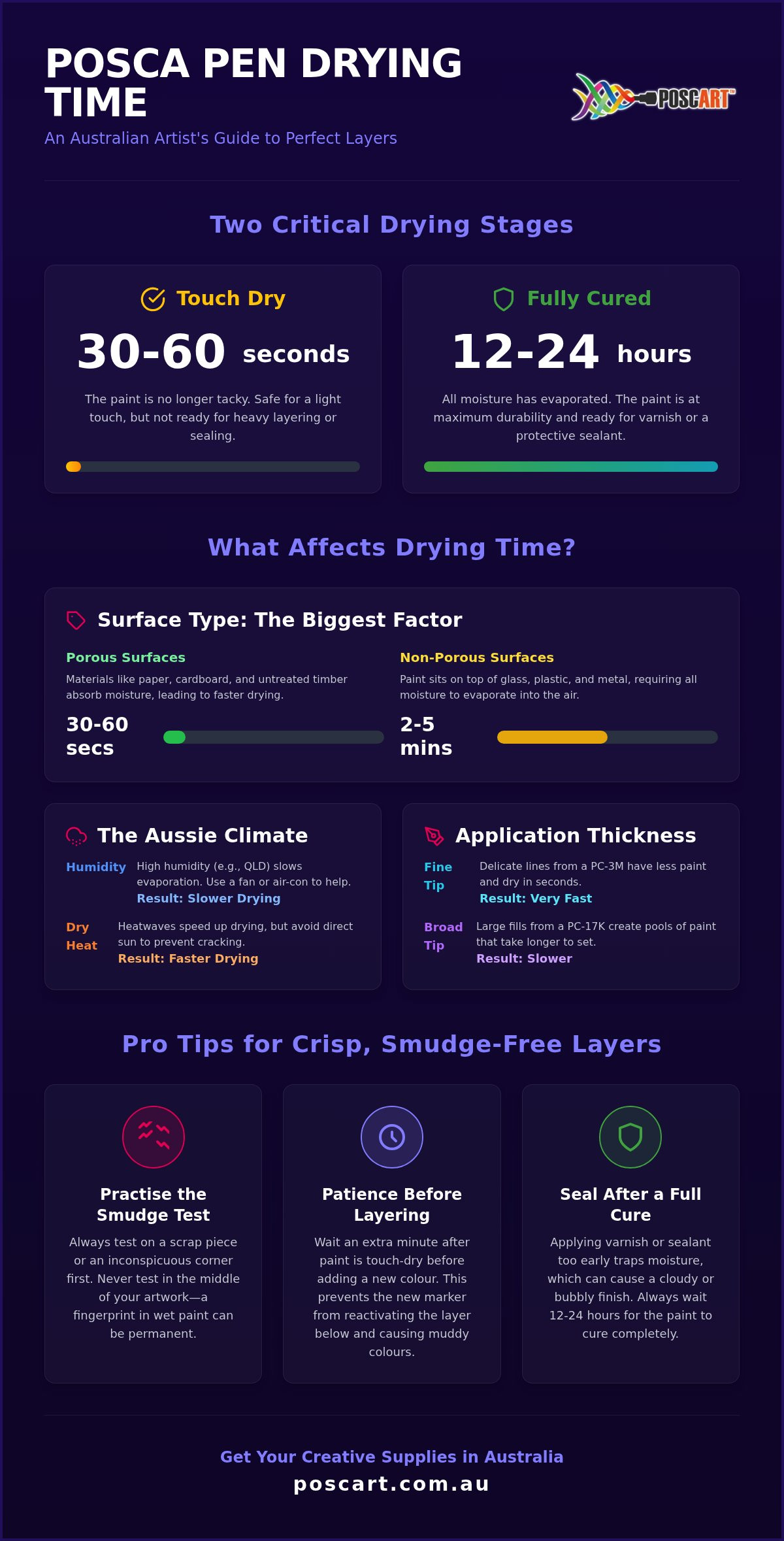
The touch dry state usually occurs within 30 to 60 seconds. At this point, the paint is no longer tacky to a light finger-touch, and you can generally move your hand over the area without a disaster. However, the paint hasn't yet reached its maximum durability. Fully cured refers to the point when all moisture has completely evaporated and the acrylic resin has bonded firmly to the surface. This process can take anywhere from 12 to 24 hours. Waiting for a full cure is essential before you apply a spray varnish, as sealing trapped moisture can lead to clouding or bubbling in your final finish.
The "Smudge Test" and Layering Safety
It's tempting to rush into your next layer when inspiration strikes, but patience is a vital tool for crisp results. To check if your base layer is ready, always perform a smudge test on a scrap piece of the same material or a tiny, inconspicuous corner of your project. Never test the centre of your piece; even a slightly wet layer can leave a permanent fingerprint in the pigment.
Waiting just one extra minute before layering prevents the dreaded muddying effect. This happens when the wet nib of a new marker reactivates the damp paint below, causing the colours to blend unintentionally. This is especially important when you are applying light colours over dark ones. By ensuring the first layer is properly touch-dry, you keep your highlights sharp and your colours true to the original POSCA palette.
Why Your POSCA Paint Dries Faster (or Slower) in Australia
Australia's diverse climate plays a massive role in how your markers behave on any given day. In tropical regions like Queensland or the Northern Territory, high humidity can significantly extend the posca pen drying time. When the air is already saturated with moisture, the water in the acrylic pigment cannot evaporate easily. Conversely, a dry heatwave in the southern states acts like a giant hair dryer. It pulls moisture out of the paint almost as soon as it hits the surface.
The thickness of your application is another major variable you need to consider. A delicate line from a PC-3M fine bullet tip will be touch-dry in seconds because there is very little volume to evaporate. However, if you are using a PC-17K chisel tip to fill a large background, the heavy pool of paint will take much longer to set. Surface temperature also dictates the flow. Painting on a hot metal letterbox in summer might cause the paint to dry too quickly, while cold glass in winter can keep the ink fluid for minutes.
Managing Environmental Variables
If you are working in a humid environment, you can regain control by using a simple desk fan or air conditioning to encourage airflow. This helps the water-based ink set more predictably. While heat generally speeds things up, you should avoid working in direct, harsh Australian sunlight. Rapid drying in extreme heat can cause the paint to contract too quickly. This often leads to visible cracking or flaking on your finished piece. If you are struggling with a specific project, reach out to our creative support team for practical tips on managing your environment.
Surface-Specific Drying Times and Pro Layering Tips
The material you choose is the single biggest factor in determining your posca pen drying time. Porous surfaces like paper, cardboard, and untreated timber are the most forgiving. Because these materials absorb some of the water content, the paint is usually touch-dry within 30 to 60 seconds. This fast turnaround makes them ideal for quick-paced sketching, classroom projects, or even hand-decorating personal stationery. If you are using your skills to create memorial cards and need guidance on the correct etiquette, click here.
Non-porous surfaces like glass, plastic, and metal require significantly more patience. Since the paint sits entirely on top of the material, it can take between 2 and 5 minutes to become touch-dry. If you are working on customising a phone case or a window display, you must allow for this extra buffer to prevent accidental smears. For a deeper dive into material preparation, check out our guide on What Surfaces Do POSCA Pens Work On?
When working with fabric and textiles, the rules change slightly. You must allow the paint markers to air dry completely before attempting to fix the design with an iron. Rushing the heat-setting process while the paint is still damp can cause the pigment to bleed into the surrounding fibres, ruining the crispness of your illustration.
How to Speed Up POSCA Drying Time Safely
If you are on a tight deadline, you can safely use a hair dryer to accelerate the process. Always use a low, cool setting and keep the dryer at least 20cm away from your work. Avoid high heat at all costs; extreme temperatures can cause the acrylic binder to bubble or warp, especially on plastic or thin paper. It's also much better to apply two thin, even coats rather than one thick glob of paint. Thin layers dry faster and provide a more professional, durable finish.
Fixing Smudges and Mistakes
Mistakes are part of the creative journey. If you smudge a wet area, resist the urge to wipe it immediately, as this usually spreads the pigment further across your canvas. Let the smudge dry completely first. Once dry, you can often gently scratch away the excess paint from non-porous surfaces or simply paint over it. A white POSCA pen is an essential tool for corrections; its high opacity allows you to mask errors and refine your edges once the underlying mistake is no longer wet.
Master Your Creative Flow with Confidence
Mastering the technical nuances of posca pen drying time is the secret to achieving a high-quality finish. It moves your work beyond simple sketches into the realm of professional-standard art. By respecting the transition from touch-dry to fully cured, you protect your intricate details and ensure that any finishing coats remain clear and stable. Whether you are navigating a humid Queensland summer or a dry Victorian winter, your environment becomes a partner in your process rather than an obstacle.
At PoscART, we provide more than just premium tools; we offer the expertise to help you excel in every creative project. Our specialist team is committed to supplying genuine POSCA markers with reliable Australia-wide shipping to keep your studio stocked. If you have questions about a specific surface or technique, explore the full range of genuine POSCA markers at PoscART today and discover the tools that suit your style. We look forward to seeing your next vibrant masterpiece come to life.
Frequently Asked Questions
How long should I wait to layer my markers?
You should wait at least 60 seconds when working on most paper surfaces. If you are painting on non-porous materials like plastic or glass, the wait time increases to between 3 and 5 minutes. Patience is vital for a crisp finish.
When you're layering a light colour over a dark one, ensure the base is completely matte and touch-dry first. This simple step prevents the pigments from mixing and creating a muddy effect that can ruin your fine details.
Is it safe to use a hair dryer to speed up the process?
Yes, you can use a hair dryer to accelerate the posca pen drying time, provided you use a low, cool setting. Hold the dryer at least 30cm away from your project to maintain an even airflow. It's an effective way to keep your creative momentum going during larger projects.
Avoid using high heat. Extreme temperatures can cause the acrylic paint to bubble or crack; it might even damage the delicate tip of your marker if you're drying while still painting.
Why is my paint taking longer than usual to dry?
Slow drying is usually caused by high humidity, a very thick application of paint, or a non-porous surface like metal or treated plastic. If the air in your studio is damp, the water in the pigment simply can't evaporate as quickly as it should.
You can fix this issue by moving to a room with better airflow or using a dehumidifier to help the moisture escape. Ensuring you apply thin, even coats will also help the posca pen drying time stay within a predictable range.
When does the paint become permanent on my project?
While the paint becomes touch-dry in minutes, it takes approximately 24 hours to fully cure and bond to the surface. This curing period is when the acrylic resin completely hardens, ensuring durable and reliable results for your artwork.
On non-porous surfaces, the paint is never truly permanent and can be scratched away unless you seal it. We recommend applying a clear acrylic varnish only after the full 24-hour period has passed to ensure your design remains protected for the long term.
General Information
This article is provided as general information only to help customers compare and choose POSCA markers, acrylic markers, art supplies, creative tools and related products. Product details, colours, finishes, surface suitability, availability, pricing and usage results may vary. Always check the individual product page, manufacturer information, age guidance, surface instructions and safety recommendations before purchasing or using a product.