
What if the secret to a professional finish isn't your artistic technique, but the two-digit code printed on the side of your marker? For many Australian artists, the difference between a crisp outline and a messy smudge comes down to decoding the numbering system. Having posca pen sizes explained clearly is the first step toward building a toolkit that works for your specific style. We know it's frustrating to wait for a delivery only to find the nib is far too thick for your fine detail work or too small to saturate a large canvas.
We believe that choosing your supplies should be as inspiring as the project itself. This guide helps you master the complete range of POSCA tip sizes so you can select the right tool for any surface, from porous wood to smooth glass. You'll gain a clear understanding of everything from the 0.7mm PC-1MR ultra-fine tip to the expansive 15mm PC-17K chisel. We'll break down the millimetre widths of every model and show you exactly which tips to use for intricate linework versus broad coverage, giving you the confidence to organise your collection and get back to creating.
Key Takeaways
- Learn to decode the POSCA naming convention to identify the specific tip shape and millimetre width of every marker in your collection.
- Discover the technical differences between fine-point models, including the ultra-fine PC-1MR and the versatile PC-3M for precise linework.
- Master the medium and broad range with our posca pen sizes explained guide to ensure you select the perfect width for both outlines and solid fills.
- Understand when to reach for specialised tools like the PCF-350 Brush Tip for calligraphy or the extra-broad PC-17K for large-scale mural projects.
- Apply the "Three-Pen Rule" to curate a balanced art kit that provides the ideal combination of detail, coverage, and bold impact for any surface.
Understanding the POSCA Marker Range and Tip Variations
POSCA markers aren't just standard art tools; they're precision instruments engineered by Uni Mitsubishi Pencil. This manufacturing heritage ensures that whether you pick up a tiny 0.7mm tip or a massive 15mm chisel, the water-based pigment ink remains consistent. It's lightfast, opaque, and designed to behave exactly the same way across every single size in the range. This consistency allows you to layer different colours and sizes without worrying about technical conflicts or ink bleeding.
Every marker in the collection follows a strict naming convention that helps you organise your studio. The "PC" at the start simply stands for POSCA, but the characters that follow are where the magic happens. By learning to read these labels, you can avoid the common mistake of ordering a pen that's too thick for your fine details or too small for a large canvas. Having posca pen sizes explained through this technical lens makes it much easier to build a professional-grade toolkit.
To get a visual sense of how these sizes compare in real-time, watch this helpful video:
Decoding the POSCA Numbering System
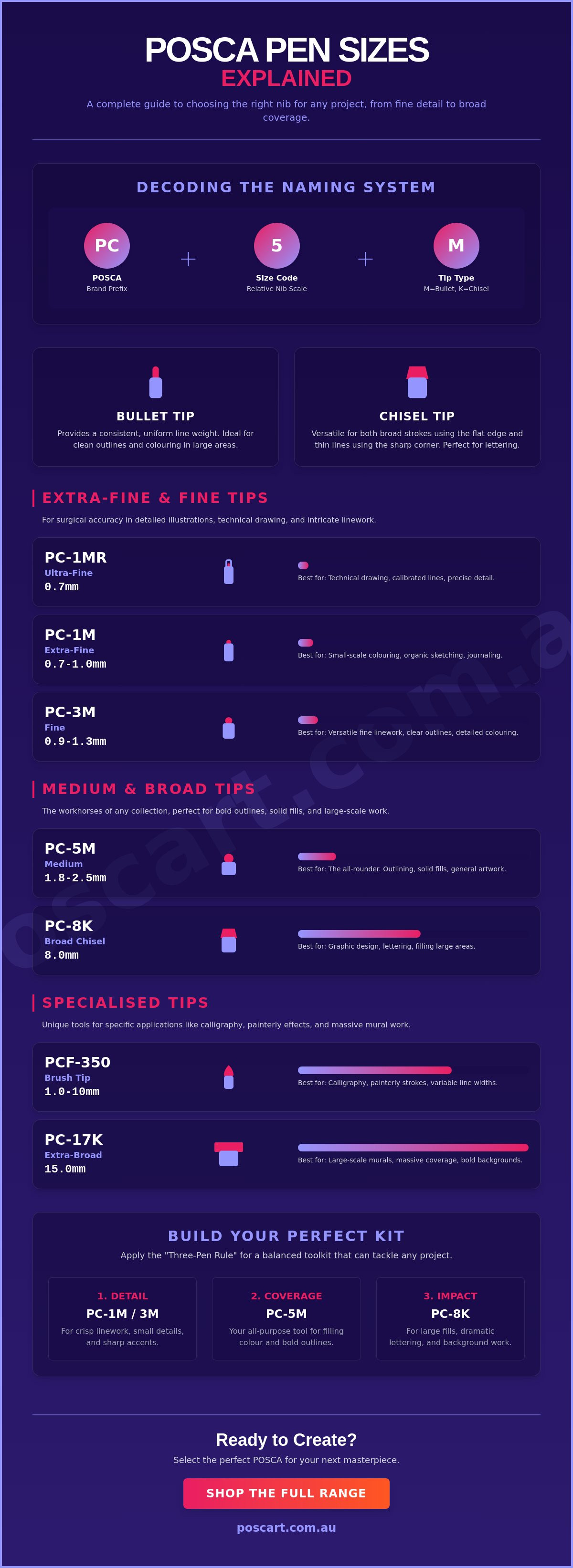
The numbers 1, 3, 5, 7, 8, and 17 represent the relative scale of the nib. While they don't always correspond directly to a single millimetre measurement, they indicate where the pen sits on the spectrum from ultra-fine to extra-broad. For example, the POSCA PC-5M is widely considered the standard medium size for most Australian artists. When you see an "M" on the barrel, it usually indicates a Bullet or Medium tip, whereas "K" stands for "Kaku" (the Japanese word for square or angled), representing the Chisel tip. Understanding this shorthand is the best way to posca pen sizes explained for your own buying process.
The relationship between the internal valve-action mechanism and the nib material is crucial. Finer tips often use plastic or metal-encased housings to maintain precision, while larger individual POSCA pens use high-density acrylic fibres. These fibres are designed to saturate the surface with paint without fraying, even when you're working on rougher textures like stone or timber.
Bullet Tip vs Chisel Tip: The Basic Choice
Choosing between a bullet and a chisel tip often defines the final look of your artwork. Bullet tips are rounded, providing a consistent line weight regardless of the angle you hold the pen. They're the go-to choice for colouring in and creating clean, uniform outlines. Chisel tips, found on broad models, offer more versatility for those who practise lettering or graphic design. You can use the flat edge for broad strokes or the sharp corner for thinner lines. Beyond these, the range also includes specialised Brush and Mop shapes for those seeking painterly effects or massive coverage.
Fine and Extra-Fine Tips: PC-1MR, PC-1M, and PC-3M Details
Precision is the backbone of any detailed illustration. When you need surgical accuracy, having posca pen sizes explained helps you distinguish between the technical feel of the 1MR and the organic flow of the 1M. These smaller models are the absolute favourites for bullet journaling and intricate linework because they allow for tight control without the ink flooding the page. By understanding the nuances of these fine tips, you can avoid the frustration of a line that's just a fraction too thick for your vision.
PC-1MR vs PC-1M: Which Ultra-Fine is for You?
The PC-1MR Ultra-Fine (0.7mm) features a unique metal-ringed tip that produces a calibrated, unchanging line. It's built for technical drawing where every stroke needs to be identical. In contrast, the PC-1M Extra-Fine (0.7mm to 1.0mm) uses a traditional bullet shape. This makes the 1M better for small-scale colouring and organic sketching. If you're working on smooth art paper, the 1MR is exceptional. However, on slightly toothy surfaces, the 1M bullet tip is less likely to snag or spray. Both models are essential for artists who specialise in miniatures or high-detail portraits, adhering to the technical standards maintained by Uni Mitsubishi Pencil.
Mastering the PC-3M for Outlining
The PC-3M Fine (0.9mm to 1.3mm) is the essential detailer for most Australian artists. It's widely considered the go-to for rock painting outlines because the tip is sturdy enough to handle the texture of stone while remaining fine enough for facial features or patterns. Unlike the ultra-fine models, the 3M allows for subtle blending if you work quickly while the paint is wet. Many creators start their collection with PC-3M bundles to ensure they have a full spectrum of outlining options ready for any project.
One detail often missed in guides is how to maintain these smaller nibs. Fine tips are more prone to picking up surface fibres, which can lead to clogs. If your 1M or 3M starts to feel scratchy, you can actually remove the nib and rinse it under lukewarm water. For pens that have seen heavy use, keeping a few replacement nibs on hand is a cost-effective way to extend the life of your marker. This keeps your lines crisp and your ink flow consistent without the need to replace the entire pen.
If you're unsure which fine tip suits your specific paper type, feel free to ask our creative team for personalised advice on your next setup.
The Versatile Medium and Broad Tips: PC-5M, PC-7M, and PC-8K
While fine tips handle the intricate details, medium and broad markers are the heavy lifters of any creative studio. These sizes are designed to cover more ground quickly while maintaining the vibrant, opaque finish that artists expect. Having these specific posca pen sizes explained is vital because the transition from a bullet tip to a chisel tip changes how you interact with your surface. These markers are particularly effective on porous materials common in Australian DIY projects, such as raw timber, terracotta pots, and even surfboards.
Why the PC-5M is Australia’s Favourite All-Rounder
The PC-5M Medium Bullet (1.8mm to 2.5mm) is the undisputed king of the range. It's often called the "Goldilocks" size because it's neither too thick for basic outlines nor too thin for filling in medium-sized shapes. In Australia, the PC-5M has become the industry standard for surfboard art and customising skate decks due to its durability on curved surfaces. According to the official POSCA guide, a single PC-5M marker can produce a continuous line approximately 230 metres in length. This impressive coverage makes the PC-5M individual range a cost-effective choice for students and professionals alike.
Broad Strokes: PC-7M and PC-8K for Large Scale
When your project moves beyond the sketchbook and onto a large canvas or shop window, you need the PC-7M and PC-8K. The PC-7M Large Bullet (4.5mm to 5.5mm) is designed for bold outlines and filling large areas without the visible "streaking" that smaller pens can leave behind. Its rounded tip ensures a consistent flow of paint even when you're working at a fast pace. For those focused on graphic design or street art styles, the PC-8K Broad Chisel (8.0mm) is the superior tool. Its angled tip allows you to create sharp, architectural lines or broad, sweeping strokes just by changing the angle of your wrist.
Maintaining these larger markers requires a slightly different approach than the fine-point models. Because the reservoirs are larger, you must ensure the internal ball bearing is thoroughly mixed before every use. If you notice the paint becoming transparent, give the pen a vigorous shake with the cap on. Over time, large fibre nibs can become saturated with dust from surfaces like terracotta. If the flow becomes restricted, you can easily pull the nib out and flip it around or replace it entirely. Keeping a small stock of replacement nibs ensures your broad markers always deliver the punchy, opaque colour needed for professional signage and mural work.
Specialised Application: PCF-350 Brush, PC-17K, and the MOPR
Standard bullet and chisel tips are the workhorses of the art world, but specialised models allow you to push the boundaries of what paint pens can achieve. Having these unique posca pen sizes explained is essential for artists moving into murals, street art, or delicate calligraphy. These tools don't just change the line width; they change the entire application method, allowing for textures and effects that a rigid nib simply cannot produce. Whether you are painting a large-scale festival banner or a tiny, curved seashell, these specialised markers provide the technical edge you need.
The PCF-350: Getting a Painterly Finish
The PCF-350 Brush Tip behaves more like a traditional paintbrush than a standard marker. It features a soft, flexible brush that responds beautifully to hand pressure. By pressing down firmly, you can create broad, sweeping strokes, while a light touch produces razor-thin lines. This pressure sensitivity makes it the superior choice for calligraphy and organic illustrations. It is also particularly effective for painting on uneven surfaces like shells, stones, or rough bark where a hard nib might snag or spray. To keep the bristles in top condition, always store your brush markers horizontally and ensure the cap is clicked on tight to prevent the outer fibres from drying out.
For those working on a massive scale, the PC-17K Extra-Broad (15.0mm) is the muralist’s choice. This marker features a huge rectangular chisel tip that can saturate large areas of canvas or shop windows in seconds. It provides the massive coverage of a paintbrush with the clean control of a marker, making it a staple for professional sign writers and public artists across Australia.
PCM-22 MOPR: New Dimensions in Paint Application
The PCM-22 MOP'R is a revolutionary departure from the rest of the range. Instead of a fibre nib, it features a round sponge tip and a soft, squeezable barrel. This design allows for a high volume of paint flow, which is perfect for creating the "drip" effect synonymous with street-style art. You simply hold the marker vertically and squeeze gently to let gravity create controlled runs of paint. Beyond drips, the MOP'R is an exceptional tool for large-scale dot art and stamping. Because the sponge tip is so large, it consumes ink much faster than a standard pen, so it is best reserved for bold, high-impact projects where deep colour saturation is the priority.
Choosing the right specialised tool depends entirely on your desired finish. While the PCF-350 offers delicacy and flow, the MOP'R provides raw power and texture. If you need help deciding which specialised marker will best suit your specific surface or style, contact our specialist team for expert advice on your next creative purchase.
How to Choose the Right POSCA Size for Your Creative Project
Building a versatile toolkit requires more than just picking your favourite colours. To achieve professional results, you must match the scale of your marker to the scale of your surface. We recommend following the "Three-Pen Rule" to ensure you're prepared for any creative challenge. A balanced kit should include a Detail marker (PC-1M or PC-3M), a Fill marker (PC-5M or PC-7M), and a Bold marker (PC-8K or PC-17K). Having these posca pen sizes explained as a functional system allows you to layer your work logically, starting with broad base coats and finishing with fine highlights.
Surface texture plays a massive role in how a nib behaves. For porous surfaces like raw timber or terracotta, larger bullet tips are ideal because they can deposit enough paint to saturate the grain. On smooth surfaces like metal, plastic, or glass, finer tips work exceptionally well but require a steady hand to avoid slipping. Once your project is complete, you should organise and store your markers horizontally. This keeps the pigment evenly distributed and prevents the nib from either drying out or becoming flooded with ink.
Size Guide for Popular Australian Projects
Australian artists often lead the way in niche creative trends, and certain projects have clear "perfect" size combinations. For the thriving rock painting community, we suggest a three-step approach: use a PC-5M for the base coat, a PC-3M for the primary colouring, and a PC-1M for the fine details and outlines. If you're tackling surfboard customisation, the PC-5M and PC-8K are your essential tools for durability and bold visibility against the fibreglass. For teachers and students creating school posters, the PC-17K is the superior choice for headings that need to be legible from the back of the classroom.
Extending the Life of Your Nibs
You don't always need to replace a marker just because the tip looks worn. Many POSCA models, including the 3M and 5M, feature reversible nibs. If your point becomes frayed or dirty, you can simply pull the nib out with a pair of tweezers, flip it around, and push it back in for a fresh start. This simple maintenance trick can double the life of your pen during heavy use.
If a nib becomes clogged with dried paint or surface dust, don't throw the pen away. You can remove the nib and soak it in a bowl of warm water overnight to dissolve the blockage. After a thorough rinse and dry, your marker should flow like new. For pens that have been worked hard on rough surfaces like stone or concrete, keeping a small stock of replacement nibs is the most sustainable way to keep your kit in top condition. By mastering these maintenance habits, you'll feel confident that you have the right posca pen sizes explained and ready for your next big idea.
Elevate Your Next Creative Project with the Right Tip
We've explored the technical precision of the PC-1MR and the massive coverage of the PC-17K. By having the logic of posca pen sizes explained, you can now select markers based on surface texture and project scale rather than guesswork. Whether you're applying the Three-Pen Rule to a new canvas or maintaining your collection through nib flipping, your toolkit is now a professional asset. You have the knowledge to choose between the organic flow of a bullet tip and the architectural precision of a chisel edge.
As an Australian family-owned and operated business, PoscART is a genuine POSCA specialist dedicated to supporting your artistic journey. We provide fast national shipping from our creative centre to ensure your supplies arrive exactly when inspiration strikes. If you need help curating a custom bundle for a specific surface or want to verify a technical specification, reach out to our specialist team for expert guidance. It's time to grab your markers and bring those vibrant ideas to life on any surface you choose.
Frequently Asked Questions
What is the most popular POSCA pen size for beginners?
The PC-5M Medium Bullet Tip is the most popular choice for those starting their collection. It provides a versatile line width of 1.8mm to 2.5mm, which is ideal for colouring, basic outlining, and DIY projects. Because it isn't too fine or too broad, it allows beginners to practise their technique on various surfaces without the steep learning curve of more specialised tips.
Can I replace the tips on all POSCA pen sizes?
You can replace or wash the nibs on most models, including the PC-1M, PC-3M, PC-5M, PC-7M, PC-8K, and PC-17K. This is an excellent way to maintain your kit if a tip becomes clogged or worn down. However, the PC-1MR ultra-fine model has a fixed metal-ringed tip that cannot be removed or replaced, so it requires extra care during your creative sessions.
What is the difference between the PC-5M and the PC-5MR?
The PC-5M features a standard medium bullet tip, while the "R" in models like the PC-5MR indicates a calibrated, ringed tip designed for technical precision. While the PC-5M is built for general artistic flow and consistent line weight, calibrated tips produce a fixed line that doesn't vary with pressure. Having these posca pen sizes explained helps you choose the "M" series for organic work and the "R" series for architectural accuracy.
Which POSCA size is best for writing on clothing or fabric?
The PC-5M and PC-3M are the best sizes for customising fabric, as their bullet tips allow the paint to penetrate the fibres evenly. Smaller tips can sometimes snag on the weave of the cloth, while larger tips might deposit too much paint, which can lead to bleeding. Always remember to heat-set your design with an iron on the reverse side to ensure the pigment remains permanent after washing.
How do I know when my POSCA pen is running out of ink?
You'll know your marker is running out when the paint becomes transparent or the flow becomes streaky despite regular priming. A fresh pen feels heavier and has a distinct "clack" when the internal mixing ball moves. If the ball sounds like it's hitting a dry surface or the pen feels noticeably light, it's time to organise a replacement from our online store to keep your project moving.
Are the extra-broad PC-17K markers refillable?
No, POSCA markers, including the extra-broad PC-17K, are not designed to be refillable. They are factory-sealed to ensure the water-based pigment ink remains at the correct consistency and prevents leaking. While some hobbyists attempt to refill them, we don't recommend it, as it can compromise the valve mechanism and ruin your artwork with unexpected paint splatters or inconsistent flow.
What POSCA size should I use for painting on small stones?
The PC-3M Fine Bullet Tip and PC-1M Extra Fine Bullet Tip are the ideal choices for painting on small stones. These sizes provide the control needed for intricate patterns and facial features on a limited surface area. For the initial base coat on the stone, you might use a PC-5M to save time before switching to the finer markers for the detailed decorative work.
Is the brush tip PCF-350 easy for children to use?
The PCF-350 Brush Tip is better suited for older children or students who have developed good fine motor skills. Unlike the sturdy bullet tips that can withstand heavy-handed use, the soft bristles of the brush tip require gentle pressure control to achieve the desired effect. For younger children, we suggest starting with the PC-5M as it's more durable and easier to manage during supervised creative activities.
General Information
This article is provided as general information only to help customers compare and choose POSCA markers, acrylic markers, art supplies, creative tools and related products. Product details, colours, finishes, surface suitability, availability, pricing and usage results may vary. Always check the individual product page, manufacturer information, age guidance, surface instructions and safety recommendations before purchasing or using a product.


